Improve · · 9 min · By Alexandre Iwanesko
How to stop blundering in chess: training your tactics every day
How do you stop throwing away won positions with a blunder? A FIDE Master's tactics routine: Puzzle Storm, the patterns to know, accuracy over speed.
You've played a fine game: better pawn structure, better pieces, the feeling of having everything under control. The position is strategically won. Then a piece is left hanging, or a fork slips past you, and you're the one signing the scoresheet as the loser. If that sounds familiar, the good news is that it's also one of the easiest weaknesses to work on.
To stop blundering, you need to spot tactical patterns before you have to calculate them. That's trained through repetition: lots of short positions, every day. Puzzle Storm, Lichess's timed puzzle mode, is the most effective tool I know for it.
I'm a FIDE Master, and I play Puzzle Storm every morning over coffee, five to ten three-minute runs. A year ago, when I came back after six years away, my average was around 45. Today it's 80, and I spot blunders, mine and my opponent's, much faster.
Why can a single blunder ruin a won position?
Because a position can be built over thirty moves and ruined in one.
A strategic advantage builds up slowly: a weak square in the opponent's camp, a bishop better than their knight, an open file. None of these assets survives a hanging piece. A blunder doesn't shrink the advantage, it flips it, without your opponent needing to play better than you.
Try it on your last ten losses: how many came down to a hanging piece, a forgotten check or a combination you didn't see coming, in a position that was going well? It's probably the easiest improvement available to you.
What is Puzzle Storm on Lichess?
Puzzle Storm is a free training mode on Lichess. You get three minutes to solve as many puzzles as you can. They're short and get harder as you go. Every mistake costs time, streaks of correct answers earn some back. At the end, the site shows your score and your accuracy.
In three minutes you see dozens of positions, each built around one clean tactical idea. Nothing better for making those patterns familiar.
What are the alternatives to Puzzle Storm?
- Puzzle Streak (Lichess): no clock, but a single mistake ends the run. Good for working on accuracy.
- Puzzle Rush (Chess.com): the same idea as Storm, but the run ends after three mistakes.
All three complement each other. For a daily routine, I stick with Storm.
Why does pattern recognition make you improve?
A strong player doesn't win just because they calculate more. Above all, they start by looking at the right things.
Chase and Simon's work on perception in chess, back in the 1970s, showed something fairly intuitive when you think about it: a master doesn't simply see the pieces better, they recognise familiar configurations. Where a beginner sees twenty-five pieces, the experienced player already sees patterns.
See a pattern again and again, and you end up recognising it without looking for it. That changes two things:
- you spot blunders faster, yours and your opponent's;
- you prune variations earlier: a move that doesn't look like any pattern that works gets dropped without following it all the way down, and that time stays on the clock.
I don't calculate more than before. I calculate fewer useless things.
Which tactical patterns should you know?
Lichess classifies its puzzles by theme. No need to learn them all at once: these ten come up all the time.
| Pattern | The idea |
|---|---|
| Hanging piece | A badly defended or undefended piece you can simply take |
| Fork | One piece attacks two targets at once |
| Pin | A piece can't move without exposing a more valuable piece behind it |
| Skewer | A reverse pin: the valuable piece is in front, it moves, the one behind falls |
| Discovered attack | One piece moves aside and unmasks another piece's attack |
| Back-rank mate | The king is trapped behind its own pawns on the last rank |
| Deflection | A defender is forced off the square or line it protects |
| Attraction | A piece, often the king, is forced onto a trapped square |
| Overloading | A defender guards two things at once and can't hold both |
| Intermezzo | Instead of recapturing at once, slip in a stronger move |
The last four take a bit more practice: start with the first six. For the others, just look at which ones you miss most on Lichess; each theme can be trained on its own on the puzzle themes page.
In a real game, they rarely come alone. Here's a position from my first round at the Badalona Open this summer. I'm Black:
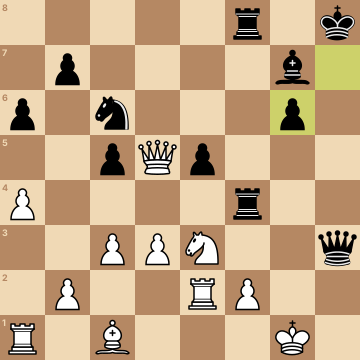
The queen covers g2 and h2, the rooks eye the f-file. The picture is already there.
White plays 25.Nf1, and the rest is forced: 25…Rg4+ 26.Ng3 Rxg3+ 27.fxg3 Rf1#.
I didn't need to calculate ten variations to find Rg4+. With the position in front of me, the pattern jumped out: the king has no squares, the f-file is ready, and the f2-pawn is the last element missing from the puzzle. All it takes is forcing it to recapture on g3. A deflection, then a mate on the first rank. Calculation was only there to check.
Does Puzzle Storm actually make you better?
Yes, but not the way people think. Storm doesn't train long calculation, the twenty-minute kind on a complicated position. It trains two things: seeing the right candidate move, and quickly calculating the short variation that follows.
That's actually what I enjoy most about it. The right move jumps out, and the next two or three moves get calculated almost instantly, with all the little side variations: the defence that blocks the check, the capture that doesn't work, the in-between recapture. By the time I play the first move, I've already checked everything. That's the reflex you take to the board.
I compare it to an athlete's stretching: nobody ever won a marathon because of their stretches, but no serious runner skips them.
I won't pretend my extra 35 points of average all came from breakfast. Over the same year I also played 188 rated games (I tell the story of that comeback in what one year back taught me). No way of knowing how much of it is down to Storm.
How do you fit Puzzle Storm into your training?
- Write down your average over a week, not your best. A best score is a lucky run; the average tells you where you stand.
- Play every day, in small doses. I do five to ten runs in the morning, fifteen to thirty minutes, and none on tournament days. No forty-run Sunday session to catch up on the week.
- Find your weak themes. Lichess shows you the themes you miss most on its puzzle dashboard.
- Work on them calmly, with no clock, calculating the solution to the end before you move.
- Track your average over a month. If the score rises but accuracy drops, you're learning to guess.
The trap: playing for the score
The point of Puzzle Storm is to calculate, not to guess.
The clock pushes you to play the first move that "looks like" the solution. If it's right, fine. If not, you lose a few seconds and move on, having learned nothing. Worse: you've just trained exactly the reflex that loses classical games, playing a move because it looks like it works.
I'd much rather see 20 puzzles solved at 100% accuracy than 30 at 60%. The first result may be lower, but every move was seen and checked. The second mostly trains luck. If your accuracy drops, slow down: the score will come back on its own.
What is a good Puzzle Storm score?
The best benchmark is still your own average over the last few weeks. A survey posted on the Lichess forum still gives an idea of titled players' average scores:
| FIDE title | Minimum FIDE rating | Average Storm score |
|---|---|---|
| Candidate Master | 2200 | 58 |
| FIDE Master | 2300 | 64 |
| International Master | 2400 | 72 |
| Grandmaster | 2500 | 81 |
My average of 80 doesn't make me a Grandmaster, as you'd guessed. Storm measures speed of recognition, not long calculation, and long calculation is what decides four-hour games.
For me, though, the most telling number is my own: 45 when I came back, 80 a year later. Six years without seeing patterns has a cost, and it can be won back.
At what level should you start?
At every level, as long as you adapt the work.
At 1200, the basic patterns aren't automatic yet, and that's what loses games. At 2000 they are, but the eye gets rusty fast without upkeep: I found that out after six years away. The difficulty adapts naturally to your level: you just get more or less far into the run.
A book, for those who prefer paper
If you prefer books to screens, I'd suggest the Encyclopaedia of Chess Middlegames: Combinations, published in 1980 in Belgrade by Chess Informant. It has since been reissued as the Encyclopaedia of Chess Combinations, also as an ebook.
Its strength: positions are sorted by theme. You work through twenty deflections in a row, and the pattern ends up feeling familiar. Work through it slowly, on a board, calculating every variation to the end. Storm for speed, the book for depth.
What Puzzle Storm doesn't replace
- Slow puzzles, where you calculate a complicated position to the end with no clock (that's what the weekly tactics are for).
- Analysing your own games, which tells you which patterns you miss.
- Long games, the only place where you learn to sustain calculation for four hours.
In short
- A position can be built over thirty moves and ruined in one.
- To stop blundering, recognise patterns, then quickly and accurately check the short variation that follows.
- Puzzle Storm trains that recognition: every day, in small doses, calculating rather than guessing.
- Storm is one part of training, not the whole of it.
If your good positions too often end in losses and you want to know which patterns slip past you in your games, that's what we work on in online private lessons.