
Tournament diary · · 37 min · By Alexandre Iwanesko
Badalona Open 2026: My Tournament Diary (50th Edition)
A round-by-round account of the 50th 'Ciutat de Badalona' International Open (Spain), 2–10 August 2026: 9 rounds and international opponents.
In a nutshell: straight on from Pontevedra — 9 rounds in 9 days in Badalona, a very international field (Spain, India, Ukraine), and a final round I couldn't play.
The Setting: 50th "Ciutat de Badalona" International Open
From August 2 to 10, 2026, the city of Badalona (Catalonia, Spain) hosted the 50th edition of its international chess Open, at the La Salut Civic Centre. A historic event celebrating its half-century with more than 200 players split into two groups by rating — I played Group A (for players rated 1950 FIDE and above).
Format: 9 rounds, Swiss system, one round per day over nine consecutive days — no double-round day, no rest day. Time control: 90 minutes for the whole game + 30 seconds increment per move. Play started at 5 p.m. each day (4:30 p.m. for the last round).
I arrived in Badalona straight off Pontevedra, with a simple goal: play solid, pick up points against the players within reach, and give nothing away against the titled ones. One detail that mattered — I knew from the start that I'd have to head back to work before the last round.
Arrival. Barcelona greeted me with brutal heat. The hotel sat a good thirty minutes' drive from the playing hall — enough to turn every trip into a small expedition under the Catalan sun. Thankfully, the tournament hall was air-conditioned: once you sit down at the board, you forget the furnace outside. I arrived motivated, but a little worn by the travel and the fatigue.
Good news for morale: I reunited with my compatriot and friend Nathan Berthelot. We've known each other for over twenty years, and it's the kind of presence that puts you instantly at ease. He'd end up landing quite a few of my preparations over the tournament — but more on that at the right moment. Small spoiler: he too was about to have a superb event.
Round 1 — Warming Up, and a King Left Out in the Open
Date: Sunday, August 2, 2026 · Black vs Navarro Perez, Pere (Spain, 1963) · Win
First round, and always that little twinge as you sit down. Across the board, a Spanish veteran — the kind of player who's seen three generations of theory come and go and whom nothing rattles anymore. No matter: with Black, I bring out my trusty Kan. I've played this Sicilian forever; it's a bit like my pair of slippers — even with heavy legs after the trip, I know exactly where to put my feet.
He carefully avoids the big theoretical lines and sets up a quiet d3 and g3, English-reversed style. No duel of memorised variations: we're going to have to actually play chess.
So I take my first long think of the game, weighing two ways to handle it: sit tight and let him come, or go and take the centre right now. I pick the greedy version — decided over the board, not out of my books: I give up the bishop pair for the centre. …Bxf3, …e5, …d5, and my knight plants its flag on d5. Objectively I'm probably a touch worse — the bishop pair always gets paid for, but later, once you've forgotten why. In the meantime, the position is very playable and I have a clear plan. That's plenty for me.
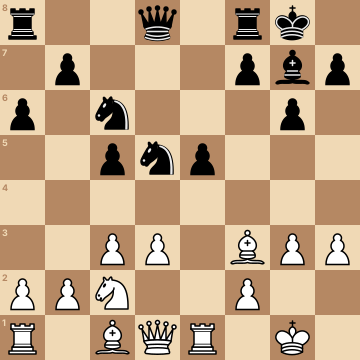
The centre against the bishop pair — a shade worse on paper, but perfectly playable.
My opponent, for his part, decides my king looks a little too comfortable. He pushes his pawns — h4, h5, hxg6 — to open lines in front of my castled king. Three moves, and my shelter looks like a building site: the h-file wide open, the g6 pawn hanging in the balance, a king getting air it never asked for. Enough to make anybody sweat. Mostly, I'm waiting for him to go all the way.
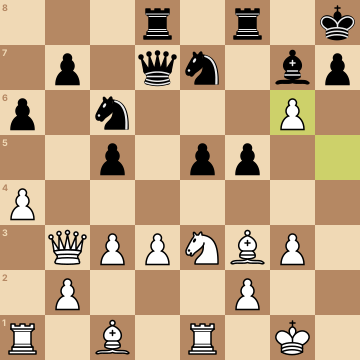
He plays hxg6 at my king… and that's exactly the moment to counter-attack.
And at last I play the move I'd been keeping warm for ten moves:
…f4!
That one earns me a small pat on the shoulder. He's the one who's been pushing pawns at my king; I return the favour and open the lines towards his. No need to calculate a mate: with every move, one more black piece invites itself in front of his castled king, and he spends the rest of the game parrying the one from the move before. By this point, I've stopped looking at my clock.
A few moves later, the whole little black army is trained on the white king: the queen on h3, the rook on f4, the bishop on g7, a knight itching to jump. Across the board, nothing answers anymore; he tries to patch things up as best he can with 25.Nf1.
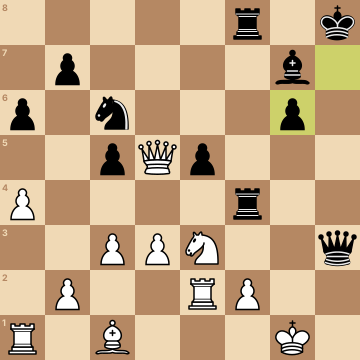
Everything's in place — White plays 25.Nf1, but nothing holds anymore.
A tactical sequence follows where everything clicks, and the game ends on a pretty mate:
25.Nf1 Rg4+ 26.Ng3 Rxg3+! 27.fxg3 Rf1#
The rook sacrifice …Rxg3+! blows up the last rampart: the f2 pawn is deflected, the f-file swings wide open, and meanwhile my queen on h3 keeps g2 and h2 under lock and key. The rook drops on f1 — mate. The detail that makes me smile: the white rook on a1, which won't have moved a single time all game, watches the whole scene without being able to recapture, blocked by its own bishop on c1. It missed everything, right down to the ending.
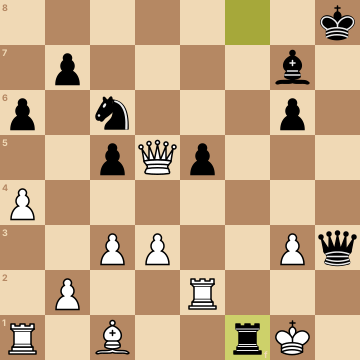
27…Rf1# — the white king trapped in his own furniture.
Takeaway: the perfect warm-up. A point in the pocket from round one, against an experienced player, with my pet opening and an attack run from start to finish. Hard to dream of a better opening to a nine-round event — especially when you show up tired and not exactly sure of your form. Which goes to show: when in doubt, you may as well put on the slippers you know.
Round 2 — The Ukrainian Actor and the Greedy Pawn
Date: Monday, August 3, 2026 · White vs Tripulskiy, Mark (Ukraine, 1792) · Win
Little pre-round ritual: I look my opponent up online. And there — fun fact — I land on his IMDb page before his ChessBase one. The kid has acted in two films. It's genuinely the first time my pre-round prep has looked like a casting sheet. Rare enough to be worth noting.
Across the board, then, a young Ukrainian with real killer eyes — the focused, determined stare that never blinks. And honestly, seeing that much determination in a young player, I find it rather cool. Form-wise, all good: a 5 p.m. round, I'm rested and ready.
I didn't have much on his repertoire, so I decided to play solid: 1.d4. We reach a King's Indian / Benoni structure, familiar ground.
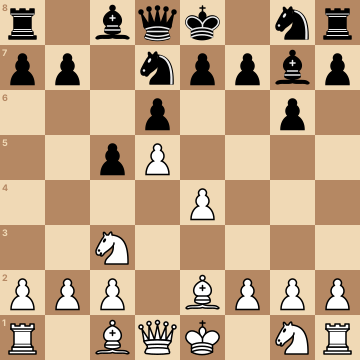
I already feel great here — and the engine will back me up.
I feel confident. To be perfectly honest, I even feel VERY clever — you know, that slightly dangerous state where you're convinced you've understood everything about the position. The engine will prove me right about the advantage… and wrong about the rest. I launch into a very ambitious plan, g4!?, to box in his pieces and, if all goes well, strip them of the very air they breathe.
And it works. I nibble squares, I lean on each of his pieces, and two or three times I even threaten to wrap things up on the spot. He ends up giving up his dark-squared bishop for my knight — the kind of concession you never sign with a smile.
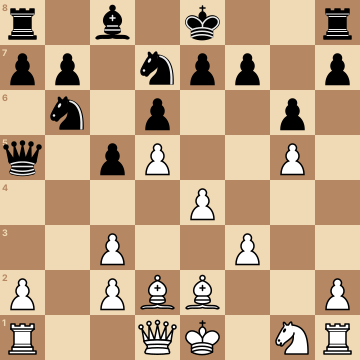
Qb1 — quiet but venomous: the black queen is cruelly short of squares.
Here I find the very precise Qb1, with a simple and thoroughly unpleasant idea for him: play on his queen's lack of squares. One more piece I'm cutting the oxygen to; he's collecting quite a set by now. All's well… until I let myself be tempted by the overly ambitious a4.
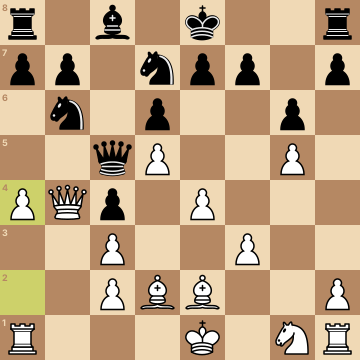
a4 — ambitious, a touch too much: it gets very hot for everyone.
All at once the calm is gone: it gets very hot for everyone, and every move has to be calculated to the millimetre. I count, I recount, I hunt for a way out in every direction — and I keep landing on the same conclusion: I'm going to lose my a4 pawn. But I'm not losing it for nothing. By the time his knight has gone to fetch it at the ends of the earth on a4, I calmly put all my pieces back where they belong.
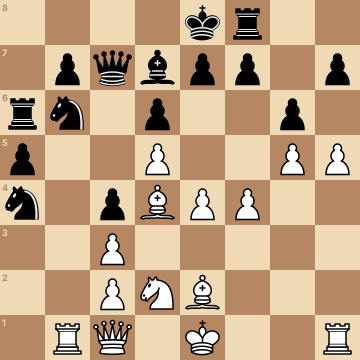
He has the a4 pawn; I have a bishop on d4, a knight on d2 and a plan. A very good trade.
I finish putting my pieces back with Bf3!… and he cracks with e5??. A decision that opens exactly the lines I was dreaming of.
A few small exchanges follow, and now I have to find the precise break:
e5!!
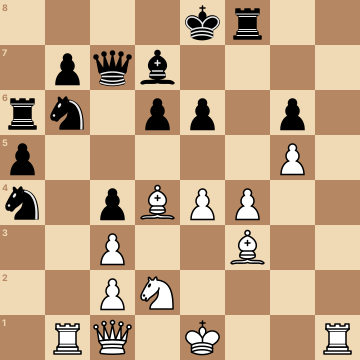
e5!! — the break that brings the black house down.
After that, all the black pieces are suddenly miserable: a knight exiled on a4, a spectator rook on a6, a bishop and a king trying to find their composure. All I have left to do is improve my own pieces and come pick off the pawns one by one: Bg4, Nf3, Nh4.
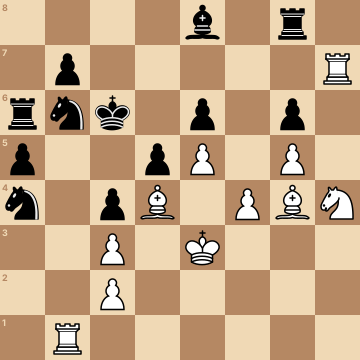
Every black piece is bad at the same time — the pawns are going to drop like flies.
The black pawns then fall like ripe fruit, and the rest is a mere technical formality.
A nice little note from the day: my friend Nathan Berthelot (rated 1950) lands a prepared line in the Italian, with a sneaky little idea, against a young Indian rated 2150 — and it goes straight through, exactly like clockwork. A very fine result for him. The tournament is off to a good start for the French delegation.
Takeaway: against a young, weaker but sharp player, solidity and a clear plan are worth gold — provided you channel the ambition. My a4 was a touch too greedy; what saved the position wasn't intuition but precise calculation at the hot moment. Feeling "very clever" is pleasant — but the board asks for the proof again every single move.
Round 3 — The Traffic Jam, the O'Kelly, and One Ambition Too Many
Date: Tuesday, August 4, 2026 · Black vs IM Utsab Chatterjee (India, 2353) · Loss
The day starts badly. Traffic jams and I reach the board 20 minutes late — the clock has started eating my time without even waiting for me. Perfect for sitting down relaxed across from an IM rated 2353. I get into the game quickly enough, but conceding a handicap like that right off the bat leaves a mark.
Against him, I bring out an O'Kelly — an experiment, to drag him off the beaten track and grab a small theoretical edge out of the opening.
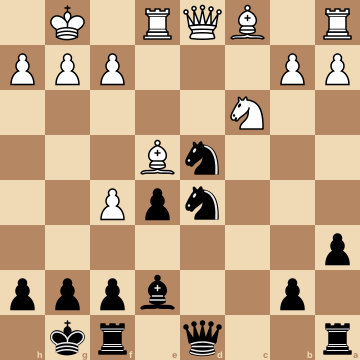
My move: I take my time to recall the right idea, Nf6!
Here I think for a while to recall the right plan — and I eventually land on the correct sequence: …Nf6! Bxb7 Ra7 Be4 Rd7!. Nothing clever about it: that's preparation coming back, not a discovery. What's rarer is the kind of position that results: White has an extra pawn and the bishop pair in an open position… and yet it's equal. All the compensation lies in the activity of the black pieces.
Except I proceed to play this perfectly equal position as if I had a win to convert — far too dynamically. That's where the dial slips: a position this lopsided throws you off. When you're holding the balance with pure activity, against an extra pawn and the bishop pair, you struggle to believe that "holding" is enough. You tell yourself there must be something in it. An error of evaluation, not of calculation — the kind you never spot in the moment.
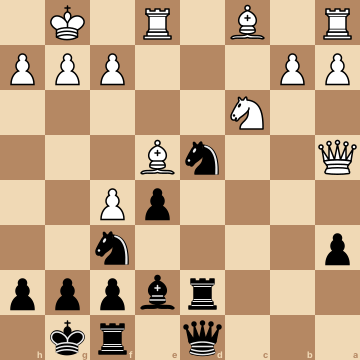
Here I had to settle things with Qc8. Instead… Bc5.
I had to set down my bags with the calm …Qc8, keep control and let my activity do the work. Instead, I charge into the very ambitious …Bc5, with a real idea behind it: plant the bishop on the a7-g1 diagonal and come hammering at f2 and g1, where his king has nobody to answer. Small snag: across the board, he plays very, very well. Every move I put down, he already has the reply — not some laboured defence found on the clock, the right one, the one that files my threat away and shuts the drawer.
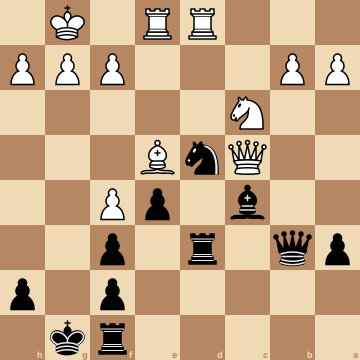
Last fork in the road: Nb5 and I suffer but defend… or the all-in Nf3.
And here comes the position where everything is decided — which I botch beautifully. I let …Nb5 slip, which offered me an inferior but defensible position, to charge headlong into an all-in with …Nf3. In the moment, that sacrifice looked far harder for him to handle than it really was. Another rushed evaluation — and this time I know exactly where it was rushed: the twenty minutes left behind in the traffic, I pay for them right here, on the move where I should have sat down and counted.
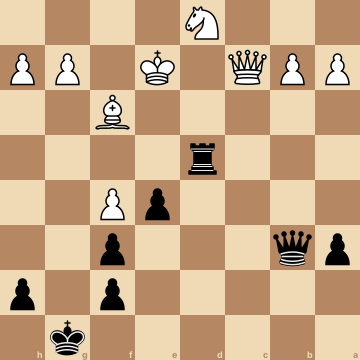
I was hoping for some play… he just rolls it out, calmly, very practically.
I was hoping to scrape together some counterplay on the d-file — double up on it, lean on his centre and force him to deal with me. He plays with maddening cold blood: not a flinch, not a needless complication, he gives back what he must and keeps a firm hand on the wheel. The Indian school in all its glory — they calculate like they breathe. And for a player as drawn to active chess as I am, there is nothing more frustrating than an opponent who politely declines the mess.
Truth be told, I've known for a good while that I'm sunk. He simply played better — nothing to say.
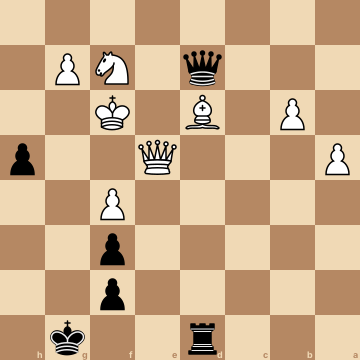
Last stand: …Qg5. He answers Qf4, and I lay down my arms.
I try a last …Qg5, he replies coldly with Qf4, and I resign.
Takeaway: I'd pulled off the hard part — equalising against the tournament's strongest opponent, in a position that was theoretically favourable to White. And I wrecked it by over-pressing, with two misjudgements in a row: …Bc5 instead of …Qc8, then the all-in …Nf3 that looked scarier than it was. Against a player who calculates that cleanly, you have to know how to accept the equality you've earned — attacking at all costs, here, just handed him targets.
Round 4 — Four and a Half Hours, and Clarity Packs Its Bags
Date: Wednesday, August 5, 2026 · White vs Tiwari, Shivansh (India, 2039) · Loss
Across the board, a 23-year-old Indian rated 2000. On paper, nothing to keep me up at night. He plays Gurgenidze or Caro-Kann. Preparing him, I spot that he flounders a bit in the Advance variation with dxc5 and a3 — so I prepare exactly that, quite pleased with my ambush.
Bad luck: he smells the trap coming and deviates with 4…Nc6. I know the critical 5.f4 is a real nest of surprises, so I'd rather keep it simple with Bb5. We reach a sort of Advance French.
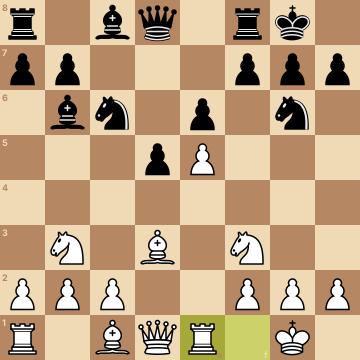
Advance French structure — and a tense choice looming for Black.
I'm not very comfortable at the thought of the very sharp …f6!: after exf6 Qxf6 Bg5 Qxb2 Bxg6 hxg6 a4!, it becomes a real bloodbath. But he prefers the quiet …Bd7. Phew.
Sensing he's not at ease, I decide to push my luck a little.
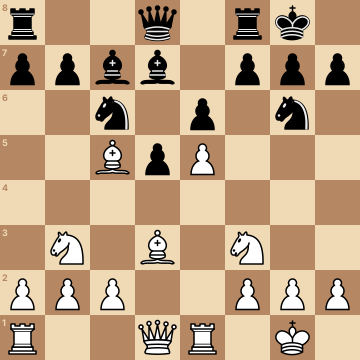
Bc5 — pretty sure he'll never sacrifice the exchange.
I plant Bc5, fairly sure he'll never have the nerve to sacrifice the exchange. Bingo: he tucks the rook back to …Re8, I retreat the bishop to Bd4, and I rub my hands. I like this position a lot.
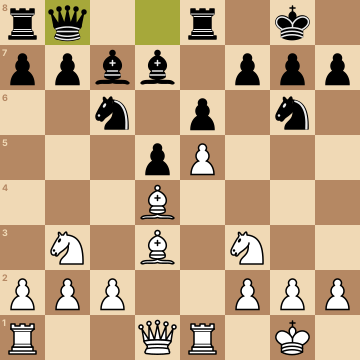
Here I think about Ng5, but nothing clear after …Bd8 Qh5 Bxg5 Qxg5 Nb4.
Here I think about going for Ng5, but I see nothing clear after …Bd8 Qh5 Bxg5 Qxg5 Nb4. So I choose Qe2. There follows …Qd8 Rad1 Nb4?.
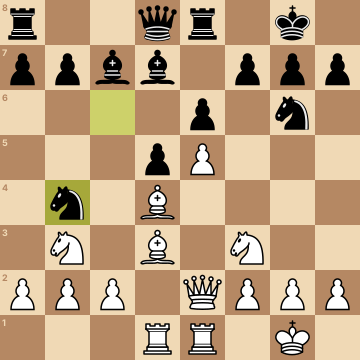
…Nb4? — and I roll out Bxg6, c3, Nc5: all the good pieces are mine.
And now I go Bxg6 fxg6?! c3 Na6 Nc5!. The knight lands on c5 and is immediately traded off — and I end up exactly where I dreamed of being: my knight against the very bad French bishop, that light-squared bishop doomed to stare at its own d5 and e6 pawns without ever getting round them. Black may pile his pieces onto the c-file, but all he has left is to defend. Exactly the position I was hoping for when preparing the game.
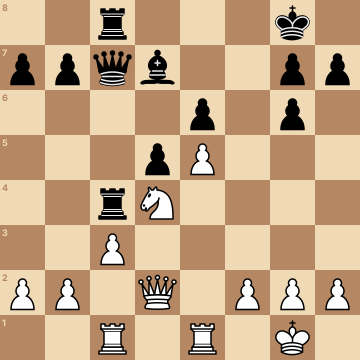
My knight against the French bishop, prisoner of its own pawns: exactly the structure I dreamed of.
Except — you're starting to know me — I'm going to want too much again. I should have played it sober, Rcd1 or h3, defusing the trouble before it even exists. But I want to mate this kid: the rook slides to f3, the queen comes to f4, and we'll see what he finds. So I play Re3?!, which hands him a dead-simple liquidation plan on a plate.
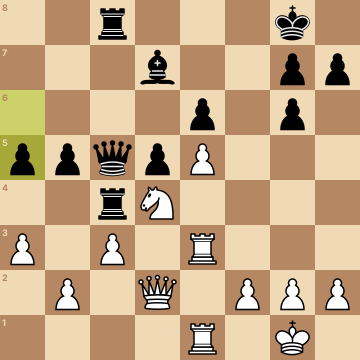
Here I had to hold with Rd3, defending everything. I go for Nb3…
Same again. I should have held the fort with Rd3, which defends everything without asking questions. Instead, I go for Nb3, with the idea Nc1-Nd3 to consolidate. Not a bad idea… just far too slow.
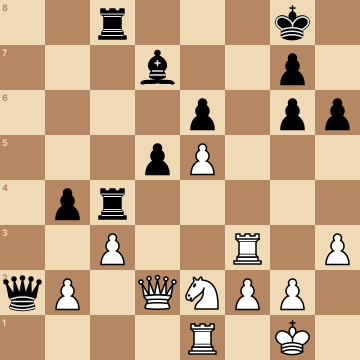
…Qa2 — he wants too much. I take the pawn; he plays Qa7 to hit f2.
Luckily for me, he too ends up wanting too much: …Qa2. I snap off the pawn, he comes back with …Qa7 to hammer at f2. The moves start pouring down — we're both in deep time trouble.
We reach a position where I feel completely winning: on …Qxe5, I answer Ng3 and it all holds. But I can't see how to finish after the defensive …Rc8… and it's a disaster.
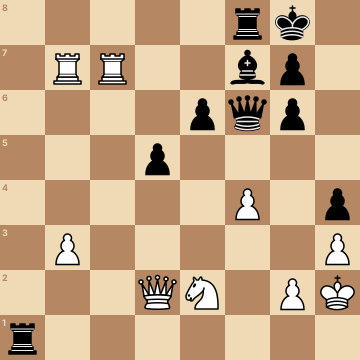
My rooks on the 7th are screaming "play me right"… I play Qe3?, and it all falls apart.
I collapse. I play Qe3?. By luck, he doesn't find the decisive …Re1! — but he still picks the strong …Rf1!. I go for b4, completely missing that …Qa1 Ng1 d4! wins the game. I should have answered …Qa1 with Rc1: the rook drops back to put out the fire on the first rank while its twin stays planted on a7. An unclear position, but one that looks VERY playable to me for White — one rook defending, one rook on the seventh, and his king no better off than mine.
Takeaway: a bitter loss. My opponent wasn't very good strategically, but he calculated very well — and above all, I clearly lost my clarity somewhere between the third and the fourth-and-a-half hour of play. Three times over (Re3?!, Nb3 instead of Rd3, then the final collapse), I chose ambition over solidity. Against a good tactician, in a 4.5-hour game, it's not talent that's missing — it's fuel. Stamina, again and always.
Round 5 — The Knight That Went on Holiday to a3
Date: Thursday, August 6, 2026 · Black vs CM Fernandez-Diaz Mascort, Miquel (Spain, 1983) · Win
Two losses in a row, and that little voice settling in: stop the bleeding. You no longer play fully free in moments like these — every move carries an aftertaste of "whatever you do, don't relapse."
Across the board, an old Spanish gentleman, a CM, about whom I know absolutely nothing. He rolls out a VERY solid English, the kind that promises no brawl but no gifts either. The perfect ground for someone who, that day, mostly wants to not lose again.
Except, as the moves go by, I notice I'm breathing rather well.
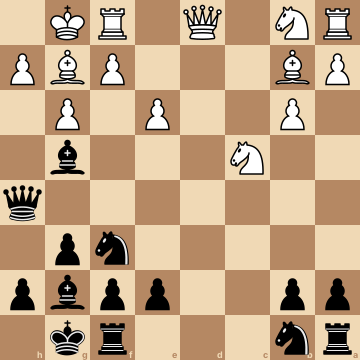
White to move — and for once, I'm the one with no problems left to solve.
With Black, I even feel a touch better: an easy position to play, not the slightest question to answer. Exactly what I needed to start breathing again.
And then he plays Nba3.
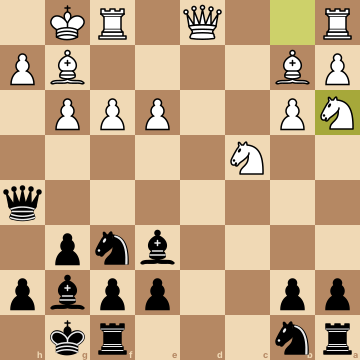
Nba3 — that knight does absolutely nothing on a3. Thanks for the gift.
That knight simply goes to the wrong square; parked on a3, it's utterly useless. The kind of move that doesn't lose the game on the spot, but suddenly makes the position far more pleasant to play… for me.
I look, I recount, and I eventually see …b5!.
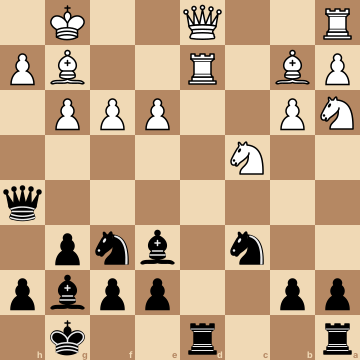
…b5! — and 20 minutes sunk into the clock, just to be sure.
This time, I don't rush. I sink 20 minutes into the clock, purely to be absolutely certain that the winning move actually wins. I run the whole line in my head, square by square:
…b5! Na5 Qc5 Kh1 Rxd2 Qxd2 Nxa5 Qxe3 Qxb5
…and at the end of the tunnel, the point I was after: …Ne4!.
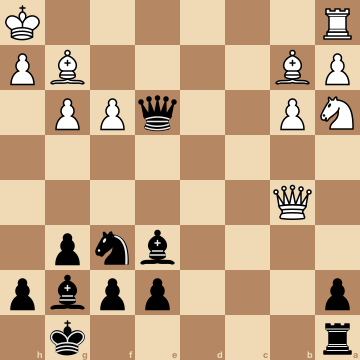
…Ne4! — the point. Once you see it, it's glaring.
A little thrill of excitement when it appears. I double-check quickly — honestly, once you see it, it's fairly obvious — and I put my hand on it. The game is over, and me, simply happy. You forget your good resolutions fast when you start winning again.
The anecdote of the day is not a minor one. A few tables over, Nathan lands a prepared line in a Sicilian against a young Indian rated 2000… and folds him in 20 moves. The whole Indian clan gathers round the board, stunned, convinced they're witnessing the coronation of an opening genius. Me, I chuckle inwardly: Nathan is, let's say it fondly, notoriously catastrophic at theory. If he swept his opponent aside in twenty moves, it's because he recited, line for line, one of my preparations. The opening genius, that day, was mostly an excellent parrot — and that's how, round after round, he'd end up landing just about all of my prep for the tournament.
Takeaway: stopping the bleeding doesn't take a flash of genius, rather the opposite — a healthy position, an opponent who puts a piece on the wrong square, and the patience to spend twenty minutes recalculating a combination you've already found. After two losses where I'd sinned through excess of ambition, it feels wonderful to win simply because I played well and calculated well.
Round 6 — The Trap That Never Sprang
Date: Friday, August 7, 2026 · White vs Lunin Bohomolets, Iliia (Spain, 1872) · Draw
Happy to go play, much less happy to discover the pairing. Across the board, an "1872" who's just dropped 120 points in a single tournament — translation: a kid far stronger than his rating, the sort to greet you with an impeccable preparation. And nothing annoys me more than these perfectly prepared kids who play for the draw. All that theory swallowed… only to try nothing.
He rolls out a Caro-Kann as square as a subway map, then follows with …Na6!?, a knight that slips out to the side to replant itself on c7.
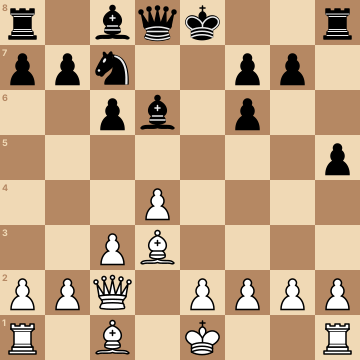
…Na6-c7 — I shrug at the time. I'll be wrong.
At the time, I shrug: pretty, but harmless. Only once the game is over do I understand that this move is flexible and poses real, concrete problems — while I was playing, I saw none of it. I was planning to trade my bad piece with Bf4 and build myself a pleasant structure; except by the time I get to it, Black no longer has the slightest worry.
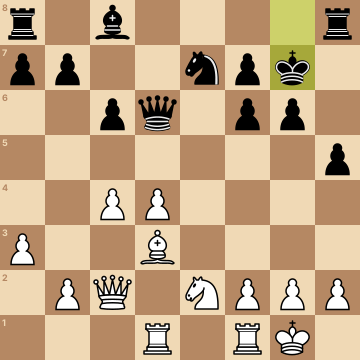
A little h3 kept the tiny edge. I play Re1. To go faster. Well done.
Here I need to play h3 — dead simple — to deny his bishop the g4 square. Without it, the bishop drops in there and trades itself off against my knight on e2: exactly the relief Black needs, and my tiny edge goes with it. Instead, I play Re1. Why? Because I wanted to play fast to put pressure on his clock. Small detail: applying pressure that way, I have no idea how to do. The result doesn't keep me waiting — …Bg4 Bxe2 — the minor pieces come off, and Black is doing great.
I stubbornly keep believing my position is worth more than that, and I blunder for real.
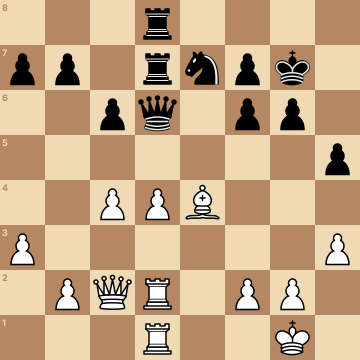
b4, Qe6, Bf3?? — and …Rxd4 lands on me. Punished.
b4 Qe6 Bf3?? — and …Rxd4 lands on me. I drop a pawn for nothing: the little pair of checks …Qe1+ then …Qe5+ forks my king and rook, and I get nothing back. That's how you turn a pleasant position into a chore, in three moves played too fast.
Except — and this is what gives me back a bit of appetite — his extra pawn is a poisoned gift. His f-pawns are doubled; that shapeless little mass isn't worth much.
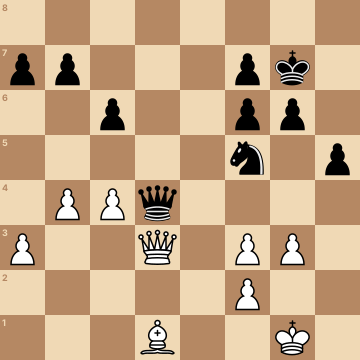
Queens off: from here I breathe. Bishop against knight, a pawn down — and serene.
He forces the queen trade to head for the endgame. Perfect: the instant the queens leave the board, I'm perfectly serene. Bishop against knight, a pawn down, and yet I know I hold.
Better still: I have a hope, quiet but very real. If Black transposes into a pawn endgame, I'm the one who wins — his doubled f-pawns become a ball and chain, my structure pulls ahead, and the win is elementary. So I watch for the moment he'll confidently trade the last pieces to "convert his pawn"…
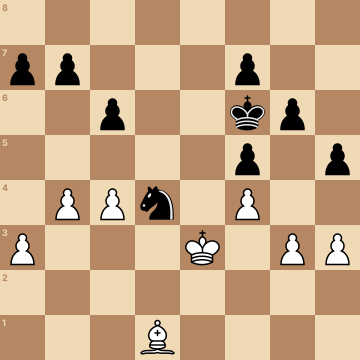
He finds neither the winning c5 nor the pawn-endgame trap. Draw.
…but he stays solid. He doesn't find the …c5! that would have given him real winning chances either — his …f5 is already dubious in practice, and he never takes the plunge. The game fades out on a clean draw, and my little pawn-endgame trap goes back in its box, untouched.
Takeaway: none. And that's exactly the problem. No grand revelation, no technical mistake to fix — just a day where I tried to go too fast, dropped my focus three times running on "easy" moves, and ended up begging a draw in a position I should have kept comfortable. The kind of game you forget… when you really shouldn't.
Round 7 — Having Fun (at 45°C)
Date: Saturday, August 8, 2026 · Black vs Carrasco Holgado, David (Spain, 2040) · Win
That day, one single urge: to have fun. No career plan, no counting of points — just play my chess and see what happens. So, with Black, I decide to carefully avoid all theory: 1.e4 e6 2.d4 a6. Yes, …a6. No preparation underneath it, no clever idea — pure improvisation.
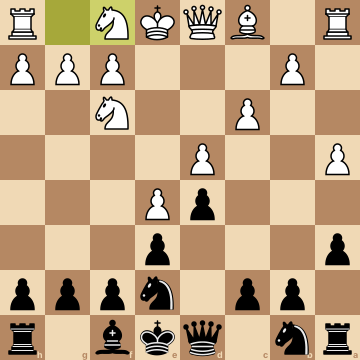
…a6 in the French — improvised from start to finish, and yet very playable.
I reach a nice Advance French. A fun little marker that comes back to me: GM Christian Bauer is a specialist of this …a6 line. Except Bauer is a player of fearsome creativity — so when it's him adopting a system, it's rarely because theory forces it. Translation: the line is no theoretical wall, I have no variation to recite and I can play the position on my own ideas. Exactly what I needed for a no-stress day.
One detail that weighs on the scales: the hall's air conditioning has given up the ghost. It's forty degrees outside, and a good forty-five inside. Staying seated is a feat — I spend half the game stepping outside for air between moves, like a diver coming up to breathe.
On the board, I hit on a move I like a lot: …c4!.
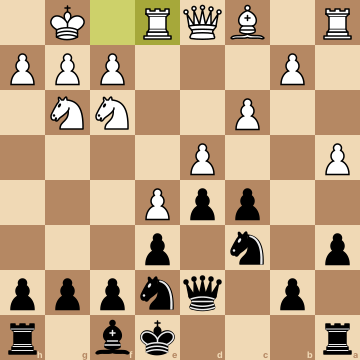
…c4 — fix the structure and come live on the weak squares b3, a4, a5.
The idea comes to me on instinct: freeze the structure and come settle on the weak squares he leaves behind — b3, a4, a5. Nothing calculated, just a hunch that smells right.
Then I launch into the move I'm proudest of in the game: …0-0-0!.
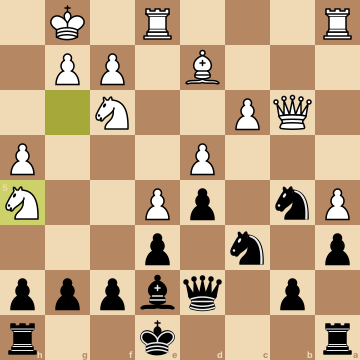
…0-0-0 — bold-looking, but Nxg7 runs into …h5 and …Rg8!
Castling long looks bold: I leave g7 hanging and I park my king on the side his pawns can come after. But I'm perfectly serene: if he throws himself at Nxg7, I calmly answer …h5 and …Rg8!, and his knight ends up a prisoner at the back of my camp. My king, meanwhile, is perfectly snug on b8.
I can then improve my pieces at leisure while he looks for a way to breathe. He ends up trying to get active by giving me a5 — a good try, honestly — but I scoop up the pawn without a second thought.
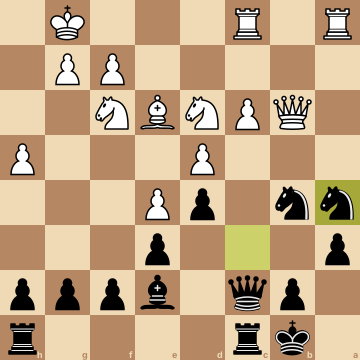
…Nxa5 — a pawn in the pocket, and a short precise series to lock everything down.
A short series of precise moves follows to stabilise everything: a pawn up, my knights screwed onto their squares, and a position I hold from end to end.
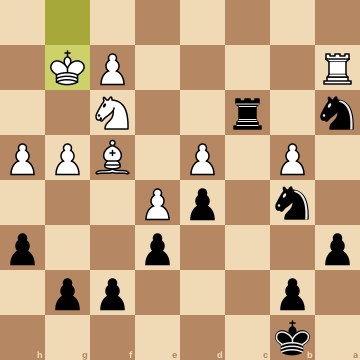
…Nc2 — the knight comes to munch d4, and that's all she wrote.
The game ends on …Nc2, which calmly comes to munch d4. Two pawns down and nothing left to hope for.
Takeaway: no grand moral — and for once, that's perfect. I had fun playing a brand-new structure, without a net, purely for the pleasure of discovery, and it worked from start to finish. Sometimes the best tournament plan boils down to one thing: rediscovering why you love this game. Even at forty-five degrees, the AC out, and two round trips per move just to breathe.
Round 8 — Proud of My Position, Right Up to the Next Move
Date: Sunday, August 9, 2026 · White vs IM Perpinya Rofes, Lluis Maria (Spain, 2149) · Loss
The last round I'll play in this tournament — I already know it, work is waiting and I won't be here tomorrow. Across the board, a seasoned Spanish IM. I prepare a Boleslavsky structure, bishop on e2, ground I find comfortable and sound.
He'll have none of it: …Nxd4, then …g6.
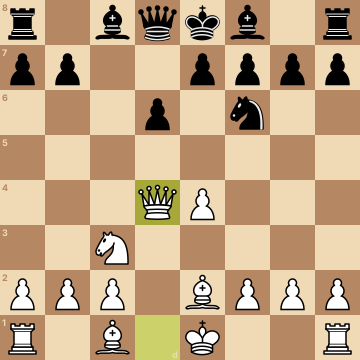
…Nxd4 and …g6 — and this is where I get carried away.
Right there, in that exact position, I do exactly what I should never do: I tank 40 minutes because e5 looks SUPER INTERESTING to me. In capitals, in my head. The kind of euphoria that should light up a red warning — when a move looks that brilliant to me, it very often isn't. I play it anyway, and drop a pawn along the way.
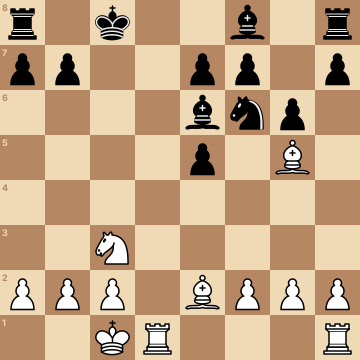
A pawn down — but his pieces are tangled and I have squares.
So there I am, a pawn behind, but with real compensation: his pieces are a bit tangled, my development flows on its own, and I hold the squares that matter — the whole d-file, plus b6 and c5, with a bishop in reserve that can come to f3 and lock down the long diagonal. His weakness is blocked stone dead. I feel good.
So I build, patiently, piece by piece: the rooks come to double up, the knight sets off for c5.
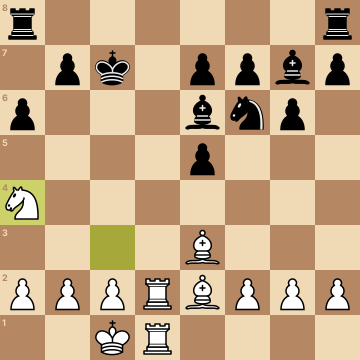
Doubled rooks, knight en route to c5: the machine is falling into place.
And I reach a position I'm very satisfied with. My doubled rooks, my bishops breathing, a knight screwed onto c5 — everything in its place.
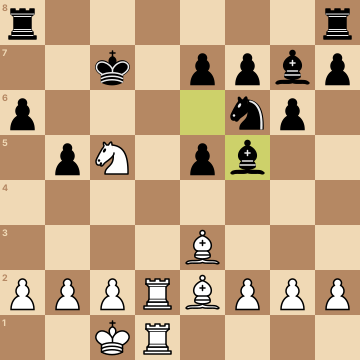
a4? b4? g4? I pick the most brutal of the three.
I spend a long time weighing my breaks. a4 would hand him weaknesses on b5 and a6; b4 would shore up my monstrous knight; g4, on the other hand, gives me the d7 square — and with it the seventh rank, which strikes me as frankly decisive. So I take the most brutal of the three.
A few moves later, the knight has to be replaced. Two squares available, one second of slack —
and it's precisely there, at the peak of my satisfaction, that I fall apart.
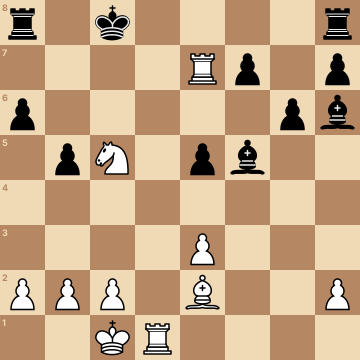
…and I play Nd7?? — when Nb7 was perfect.
I play Nd7??. A pure, dumb blunder: I'd completely forgotten that b6 was under control, which made Nb7 simply perfect. The right move was there, obvious, under my nose — and I was looking elsewhere. After that there's nothing left to negotiate: he trades, then trades again, every exchange bringing me closer to an endgame I don't want, and I have no way of stopping him. I slide into a losing rook endgame, watching every step of the staircase come.
I'm sickened. There's no other word.
Takeaway: two red warnings ignored in the same game. The first: when a move looks SUPER interesting to me, to the point of sinking 40 minutes into it, it's rarely a good sign — enthusiasm is a poor judge. The second, crueller one: the more I like a position, the more I should be wary, because it's exactly when you're admiring your own position that you stop looking at what the other side is preparing. A crystal-clear Nb7, a catastrophic Nd7, and a whole fine day's work in the bin — the night before heading back to the office.
Round 9 — The One I Didn't Play
Date: Monday, August 10, 2026 · Not played
I had to head back to work: no way to stay for the final round. I was paired against Ravi, Krishna G (India, 2072), but I didn't take my seat — so the round counts as a zero in the standings. That's the price to pay when the work calendar catches up with the chess calendar.
Final Tally
Score: 4.5 / 8 in the games played (counted as 4.5 / 9 in the standings, round 9 scoring zero). Final placing: 23rd, Elo performance 2067, for a net of −14.6 points on the FIDE meter. Four games won, one drawn and three lost — of which only one against an opponent genuinely stronger than me, the Indian IM Utsab Chatterjee (2353). The other two defeats came from players rated below my own 2150. And that last round left on the table because of going back to work.
Lessons Learned
4.5 out of 8. On paper, that's fine — a 2067 performance, a few nice games, and real moments of enjoyment. But let's be honest: I leave a little frustrated. Of my three losses, only one is truly "deserved" — the Indian IM in round 3, stronger than me, who calculated cleanly while I flailed about. The other two I handed to myself, from positions I loved. And the worst part is that these aren't new ghosts: they're exactly the same ones as in Pontevedra.
Here's what I'm packing back into the suitcase:
Channel the ambition — THE big job. Round 3, I equalise against the tournament's strongest player… and over-press an equal position. Round 4, I want to mate him and I wreck an advantage. Round 8, I admire myself, and I blunder the very next move. Always the same pattern: the moment the position is good or quiet, I push one notch too far. Accept the equality, convert without forcing — priority number one.
Beware the euphoria. When a move looks SUPER interesting to the point of sinking 40 minutes into it, or when I feel VERY clever, that's precisely when I should double-check. Enthusiasm is a poor counsellor. My finest wins (rounds 2, 5 and 7) I owe to cold calculation at the right moment, not to a rush of blood.
Stamina, again and always. My two collapses (rounds 4 and 8) come late, when the clarity gives out: after 4.5 hours of play, or in a hall at forty-five degrees, AC out. The body decides far more often than I care to admit. Same conclusion as in Pontevedra — I really need to get on it for good.
Fun remains the best fuel. My prettiest game, round 7, I played purely to enjoy myself, on an improvised and half-dubious structure. When I play my chess, without tension, it works. Worth pondering seriously.
And then there was Nathan, a few tables over, who landed just about all my preparations and put together a superb tournament — proof that a good parrot who's also a good friend is worth all the theoreticians in the world.
Final score: 4.5/8, 23rd, and a rushed departure the night before the last round, a point left on the table. Disappointing in places, joyful in others. But as long as I still find Nf1 Rg4+ Ng3 Rxg3+ Rf1# mates and f4! breaks that hit the mark, I'll know exactly why I keep coming back to sit at the board. If only, one day, to learn to keep quiet when my position is already winning.
Over-pressing a position that was already fine is the most expensive habit I know, and I spot it in the adults I coach with embarrassing ease — from the outside, naturally. If round 4 sounds like you, that's exactly the reflex we rewire in adult chess lessons in Geneva.