
Tournament diary · · 24 min · By Alexandre Iwanesko
Pontevedra Open 2026: My Tournament Diary from Spain
A round-by-round account of the Pontevedra International Open (Spain), July 25-30, 2026 — games, analysis, and lessons from a demanding tournament.
In a nutshell: a packed international Open in Pontevedra with opponents from all over — Portugal, Spain, Uruguay, Colombia — and technical lessons at every round.
The Setting: Pontevedra International Open 2026
From July 25 to 30, 2026, the city of Pontevedra (Galicia, Spain) hosted an international chess Open with over 100 players from across Europe and Latin America. FIDE classical time control, 9 rounds, a strong field.
My goals: enjoy playing, stop wrecking equal positions, and be solid.
Round 1 — The English, the Bluff, and the Spectator Bishop
Date: Friday, July 25, 2026
The first round of a tournament is always a bit special. No matter how many events you've played, there's always that slight tension when you sit down at the board. The reflexes come back quickly... but never on the very first move.
Across from me, a young Portuguese player rated around 1800 Elo. I'm expecting an energetic player, ready to calculate the slightest complication. Which is exactly why I have zero interest in turning this first game into a tactics contest.
So I decide to play the English. A first for me in classical chess. The idea is simple: get a strategic position, keep control, and impose a battle of plans rather than a battle of variations.
My opponent, however, doesn't seem familiar with the concept of thinking. He plays almost every move instantly. After a few minutes, I start looking at his clock more often than the board. Either he knows everything by heart... or he's one hell of a bluffer.
I think I've got a slight strategic edge. I've just played b5, expecting to reach a beautiful position. I love what I see: White seems to control the key squares, the pieces are harmonious, and I'm quietly getting ready to roll out my plan.
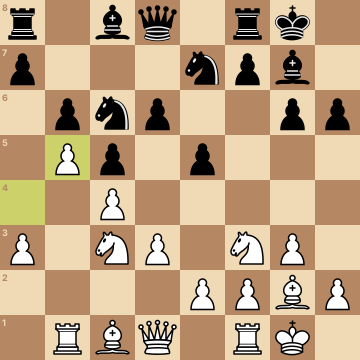
Position after 11.b5 — White is satisfied... a bit too soon.
And then comes the first bucket of cold water. Without a second's hesitation, he plays:
...Nd4!
The move is strong. Very strong. And above all, I hadn't seriously considered it — because it gives up the exchange. I probably should have played Nd2, which should have kept a small edge, but in the moment, the capture was impossible to resist. That sacrifice changes the whole dynamic of the position.
A few moves later, he finds the logical follow-up:
...d5!!
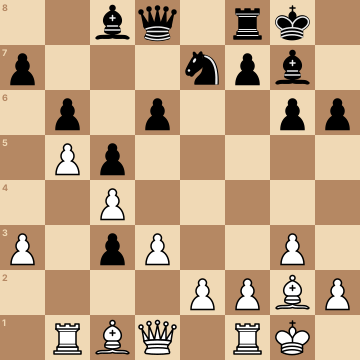
There's only one move for Black — and he found it.
There's no sugarcoating it any longer. The black knight is parked on d5 like it owns the place, the bishop pair springs to life in one go, while my poor bishop on c1 discovers an unexpected calling: watching the game up close without ever participating.
Within minutes, I go from "satisfied player" to "proud owner of the worst bishop on the board."
The decision that follows is somewhat counterintuitive: give back the exchange in order to win the c3 pawn under favorable conditions. This was clearly not the script I had imagined ten moves earlier, but strategically, it's the price to pay for a playable position.
My opponent chooses to enter an opposite-colored bishop endgame a pawn down, thinking he can hold easily. But that's underestimating White's center — and especially the g4 breakthrough.
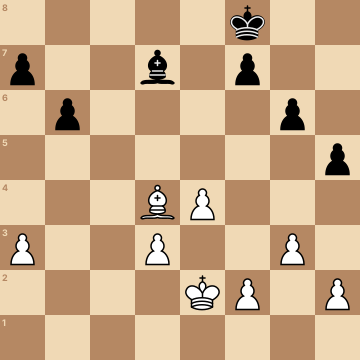
Opposite-colored bishops — but White's center will make the difference.
The plan has been clear for several moves: install a pawn on d5, gradually improve the pieces, then prepare the g4 push.
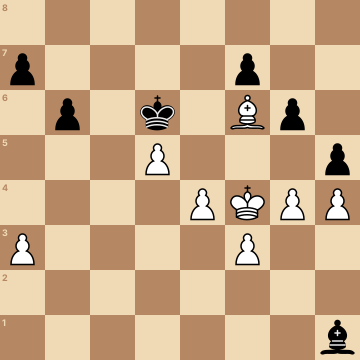
The g4 breakthrough — from here, Black's defense crumbles.
The g4 breakthrough practically decides the endgame. If he takes on g4, I create a passed pawn with h5 that becomes extremely hard to stop. If he declines the capture, I can calmly prepare the e6 break, which completely wrecks his structure.
Takeaway: this first round is a pretty good summary of what a tournament is like — for a few moves, I thought I was way cleverer than I actually was. Fortunately, endgames sometimes forgive the opening's excess optimism. And in opposite-colored bishop endings, remember this: if you get two connected passed pawns and there are still a few pawns on the board, that's often enough to make the difference.
Round 2 — When a 17-Year-Old Makes You Want to Take a Nap
Date: Saturday, July 26, 2026
First double round of the tournament. Double rounds aren't my favorite — they're exhausting, physically and mentally. Two classical games in one day means managing your energy as much as your moves.
Morning round. I'm a bit groggy, but ready to fight.
Across from me, a young Spanish prodigy, 17 years old. Peak rating around 2420, currently listed at 2365. The kind of profile that only goes up and gently reminds you that at 17, you were mostly busy missing three-move forks.
Looking at the database, I expect 1.e4 and a tense Sicilian — the natural playground of an ambitious young player looking for a fight.
Surprise: he goes for 1.b3. Not at all what I'd prepared for. Fortunately, I know the theory in these structures fairly well and I reel off my lines for a good while. We reach a relatively equal, simplified, clean position.
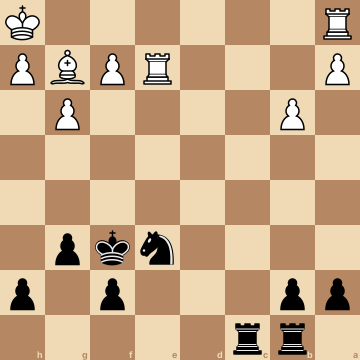
Position after 22 moves — equal on paper, but the bishop is taunting the knight.
In practice, I feel slightly worse: he has the bishop against my knight, and in this kind of open endgame, the bishop tends to stroll around like a tourist on vacation while the knight desperately looks for a stable square. But the position is very holdable, and I'm happy to have equalized against a 2365.
And I already know exactly what's coming. This kid isn't going to rush. On the contrary — he'll play very slowly, avoid pawn pushes, set subtle traps, and pounce on the slightest opportunity. The kind of silent, almost polite grind where every move looks harmless but the pressure never lets up.
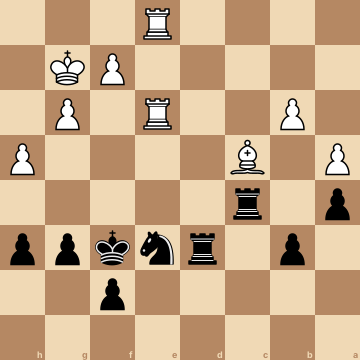
29 moves later — he has a plan, I have... a position.
Seven moves later, the picture is crystal clear. His bishop has settled on c4 like it booked a five-star Airbnb, and he's about to launch kingside pawn pushes to create weaknesses. On my side, I haven't budged an inch. My position holds, but it holds like a student holds a presentation he didn't prepare — technically standing, but without much conviction.
And then I find ...g5 — an important defensive move that finally gives my knight some life. Suddenly, it has prospects, squares, almost a reason to exist.
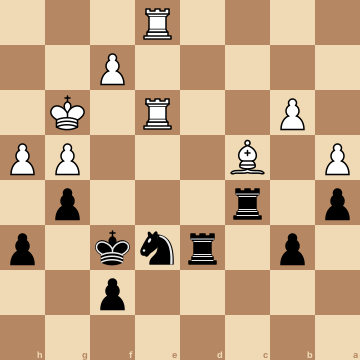
...g5 — the knight finally finds a reason to exist.
Then follows Re4 Rd4 — and he surprises me: he sacrifices the exchange. A move I clearly underestimated. The kind of decision that reminds you that 2400-level juniors aren't there just to make up numbers.
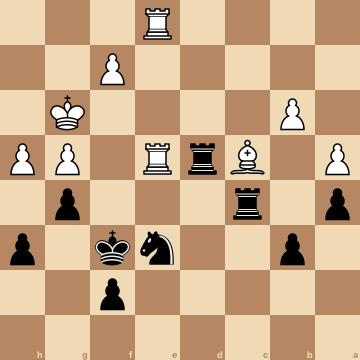
Rxe6! — yet another exchange sacrifice. A recurring theme, apparently.
33.Rxe6+ fxe6 34.Rxe6+ Kg7 35.h5 Rdxc4 36.bxc4 Rxc4 37.Rg6+ Kh7 38.Rxb6 Rxa4
Fortunately, after all the captures, I can simply give back the exchange on c4 and reach an easily drawn rook endgame. "Easily drawn" — except you still have to hold it for 30 moves against a kid who refuses to sign the draw sheet the way a teenager refuses to clean their room. But the position holds, and the draw comes through.
My opponent was serious, focused, and played exactly the way an ambitious young player should play against a tired old FM: patiently, methodically, no gifts. Nothing spectacular, but solid. The kind of game you don't lose, and where you still think "thank God I know my endgames."
Takeaway: against a young talent who grinds, don't try to shine — surviving is already a result. And always keep an eye on exchange sacrifices: this tournament has apparently decided I'll face one per game.
Round 3 — The Zombie Draw
Date: Saturday, July 26, 2026 (afternoon)
Second game of the double round. Across from me, an experienced International Master from Uruguay, rated 2310. Two tired players, one board, and a shared desire to above all not do anything stupid.
I get the theory wrong fairly early — the kind of slip you'd never make fresh and rested, but that happens naturally when your brain is running in power-saving mode. He equalizes without breaking a sweat. On my side, I flatten the position as much as possible: if I can't win, at least I can make sure I don't lose anything.
He offers a draw pretty quickly. I don't need long to think about it.
Takeaway: sometimes, the best game is the one you don't really play. A clean half-point against an IM at the end of a double round is a result you take without asking questions — and forget immediately so you can go to sleep.
Round 4 — When You Think You're Tal
Date: Sunday, July 27, 2026
I arrive motivated. The tournament is going well — 2/3 with a draw against an IM, now's the time to push for the full point.
A Najdorf — a first for me in classical chess. I target him on a line with g3 and get a good position.
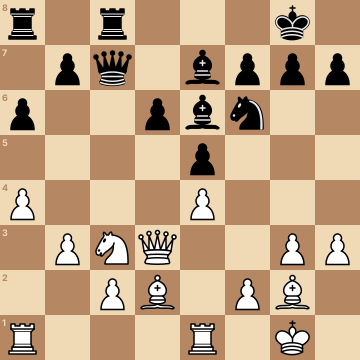
Position after 15 moves — White is well set up in the Najdorf.
I find the creative (for me) Bd8! with the idea of activating it via b6. One of those moves that makes you feel like a genius for about five minutes. He goes for the most aggressive line — and I counter with the sequence d5! exd5 e4! which blows the position wide open in my favor.
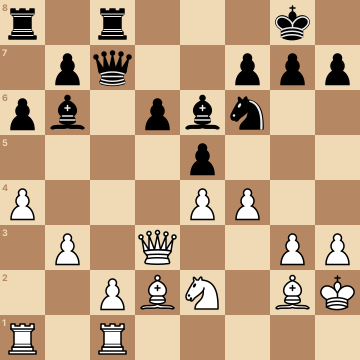
d5! exd5 e4! — the center explodes in Black's favor.
After the tactical flurry, I reach a promising position. Ten minutes on my clock against fifteen on his — and instead of settling quietly onto my advantage, I almost instantly grab the wildly ambitious ...Bxh3, channeling my inner Tal. I had completely overlooked the simple sequence ...Qc7, Rd1, Bg4!! which wins by force — cleanly, no drama, no dubious sacrifice.
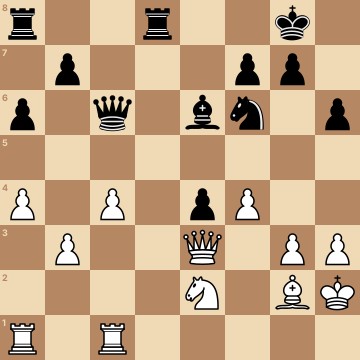
Here I played ...Bxh3. Tal would have made it work. I didn't.
We reach a position where he's almost completely paralyzed. The kind of diagram you proudly show your friends saying "look how winning this was."
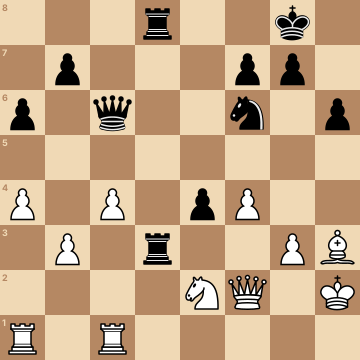
Almost paralyzed — but "almost" doesn't count in chess.
But the Colombian IM finds all the right defensive moves — coolly, methodically, without panicking. And on my side, the moves become extremely hard to find. With 10 minutes on the clock, I can no longer calculate the continuations properly. Lack of clarity, and he ends up winning.
Takeaway: when you're dominating, stabilize and convert — don't improvise Tal-like sacrifices. Especially when you're not Tal.
Round 5 — The Old Fox's Trap
Date: Monday, July 28, 2026
Another double round. After yesterday's loss, I need to bounce back — but without wasting energy. Against a young Spaniard rated 2076, I pull out b3 Bb2 to dodge any preparation. And I blunder a pawn. That's what happens when you play the opening on autopilot.
Except the position is actually less dire than I thought during the game.
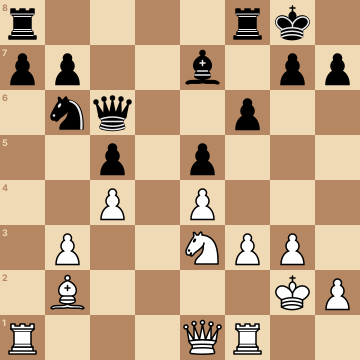
A pawn down — but not the end of the world.
He goes for a very direct plan, and I set a little trap. Here, he plays Re8 with tempo — and I don't hesitate.
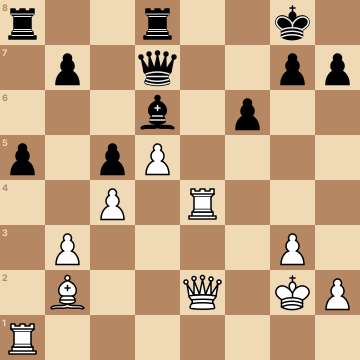
Rxa5! — the kind of move that takes the wind out of your opponent's sails.
Rxa5!
Objectively, the position stays roughly equal. But across the board he doesn't know that yet — and that alone is worth half a pawn.
He doesn't find the best defense, and we reach a position where I spend 35 minutes trying to find a win. After Rh8, Kg6!! holds for Black and I can't find anything clear. I end up going for Re6 and keep pressing.
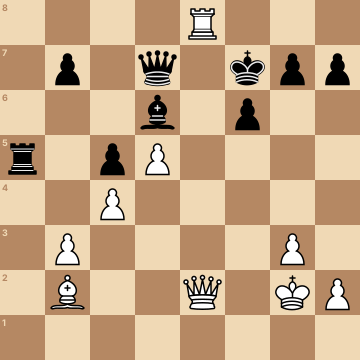
35 minutes on this position — and still no clear win.
The real ambush arrives now. I play the sneaky Qc2 — a move that looks like it's preparing Qxh7 for a draw. He goes straight for Be5, thinking he's cutting me off.
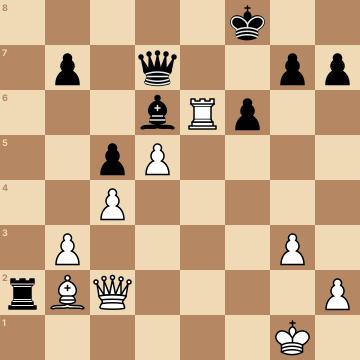
Qc2, Be5... Qf5! — the trap snaps shut.
Except I play:
Qf5!
Black's position collapses.
I convert the endgame without too much trouble.
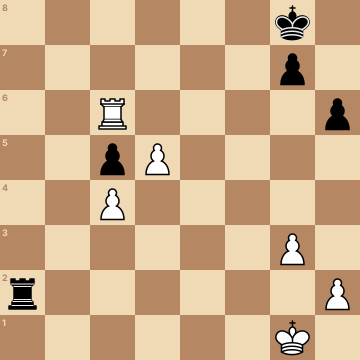
Endgame converted — experience sometimes makes the difference.
Takeaway: never play on autopilot. Ever. I got a bit lucky on this one — next time, the blundered pawn might not come back.
Round 6 — Ground Down by a 13-Year-Old
Date: Monday, July 28, 2026 (afternoon)
Second game of the double round. Across from me, a 13-year-old Brazilian rated 2350. Thirteen. The age when some kids discover chess; this one is already crushing FMs in international tournaments.
Very little time to prepare between the two rounds. I go for an Accelerated Dragon that morphs into an Alapin. I've just played d4 and he chooses the very solid Ne2.
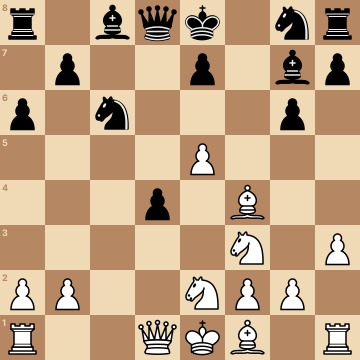
After Ne2 — solid, not spectacular, but effective.
I don't miss my chance to simplify and go for the sequence Nxe5 Nxe5 Bxe5 Bxe5 Qa5 Qd2 Qxe5 Qxd4 Qxd4 Nxd4. We reach a stripped-down position.
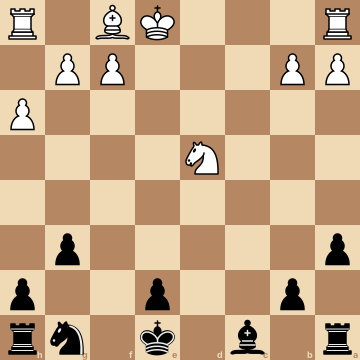
Simplified position — the engine suggests Nf6 e5 b5 to nearly equalize. Too tense for me.
The engine suggests Nf6 e5 b5 to nearly equalize, but I find that line too tense. I go for Nh6 Bc4 Rf8! with the idea of activating the rook on the f-file. I don't have the nerve to play a5 and choose the very solid Be6, because I correctly calculate that Bxb7 lets me trade everything off. He chooses to exchange bishops.
After a few trades, we reach this position that he fully intends to grind.
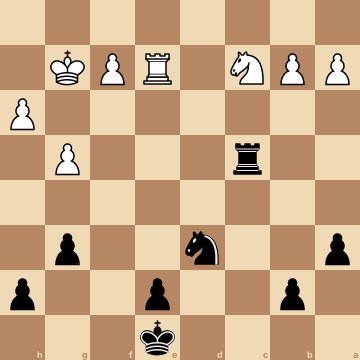
The grind begins — it's hot, I look tired. He doesn't.
It's hot in the playing hall. I look tired. He has the energy of a kid who just discovered an all-you-can-eat candy buffet. He's a bit imprecise, and I reach a position that starts looking threatening for Black.
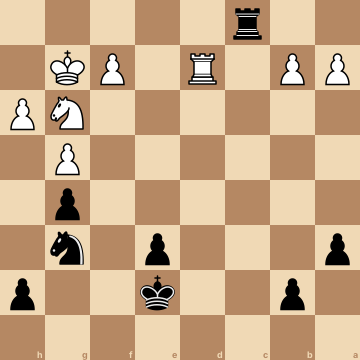
The position is turning — but you still have to find the moves.
But I'm exhausted and starting to lose clarity. Here, I see e5 — but I don't trust it. The kind of moment where you need to trust your instinct, and fatigue won't let you.
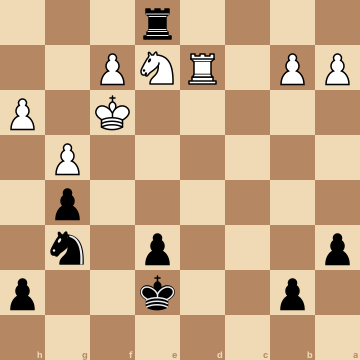
e5 was there — but fatigue had already moved in.
I get hit with Rd7 and then, in time trouble, my brain decides to take its lunch break. I blunder on nearly every move, and he ends up winning.
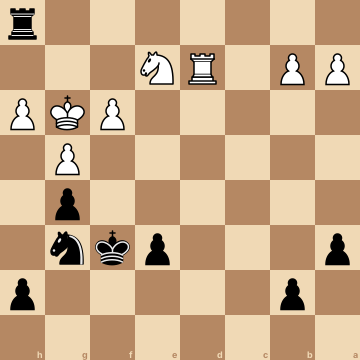
Rd7 — and after that, it's a shipwreck.
Hats off to him. At 13, grinding down a tired FM in a sweltering hall is exactly what you need to do to improve. As for me, I mostly should have drunk more water.
That said, with a name like that — Casalaspro — I probably should have taken the hint straight off the pairing sheet. I'd likely have been more than fine against Casals-amateur, or even Casals-semi-pro… but Casals-pro, well, that's immediately far too serious for me.
Takeaway: physical fitness isn't a bonus in tournament chess — it's a prerequisite. When the body quits, clarity follows, and the moves you see, you no longer dare to play.
Round 7 — The Win That Won't Come
Date: Tuesday, July 29, 2026
Clear objective: 3/3 over the last three rounds to scrape some Elo points. Across from me, a 14-year-old Spaniard. I target his French Defense — he plays a very particular setup against the King's Indian Attack, and I find a little idea to force him into a new scheme. I'm counting on his lack of experience to outplay him.
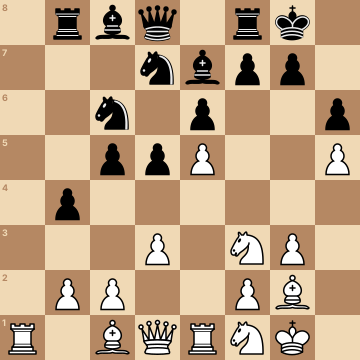
30 minutes ahead on the clock and still in preparation — the plan is working.
The preparation pays off: I have one hour against 20 minutes on his clock. And I sink forty of those minutes trying to make Nxh6 work — which doesn't work. The kind of moment where you think "I've got time, might as well look for the killer blow." Except the killer blow doesn't exist.
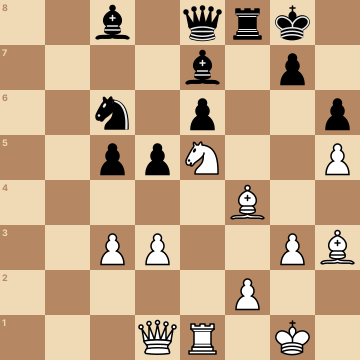
40 minutes on Nxh6 — which doesn't work. 40 minutes well spent.
I finally go for Ne5 and the grind. He plays very solidly, but I get a small edge with pressure on e6.
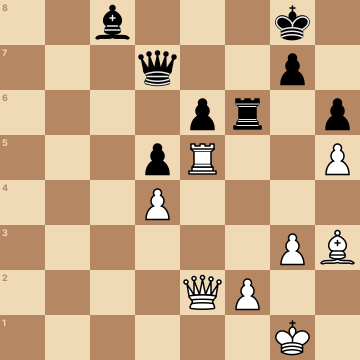
Pressure on e6 — the small edge is there, now convert it.
I grind and grind. I reach a position where I think I'm winning after Qxc4 dxc4 Bg2! — except I miss that after g5 Ra7 Bd7 Bc6, there's Be8 which holds.
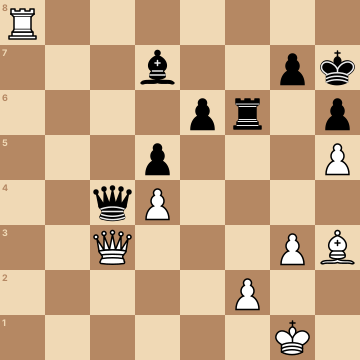
Qxc4 dxc4 Bg2! — it looks winning. It's not.
Fortunately, he goes wrong after a trap and I don't miss Bc6! which wins.
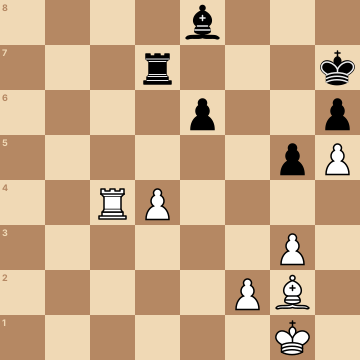
Bc6! — this time, the killer blow actually exists.
We reach a rook endgame. We've each had about one minute on the clock for a while now. After Kg7, I see that Rf4 wins by transposing into a pawn endgame. But he plays Ke6.
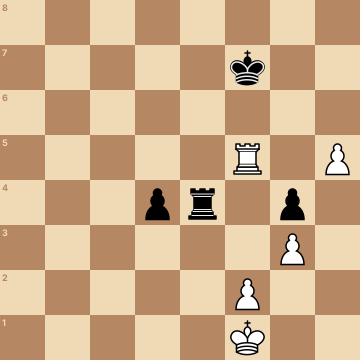
One minute each — and everything is decided now.
And I completely miss the win with Rxd4. Another lapse in clarity — the fourth hour of play, always that same hour.
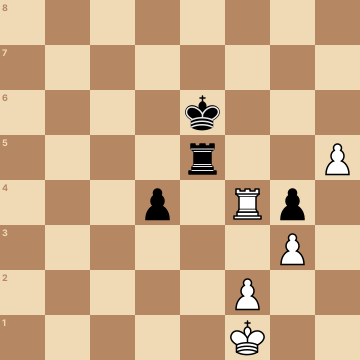
Rxd4 was winning — but with one minute on the clock, you can't win much.
I miss my last chance to win with Rd8.
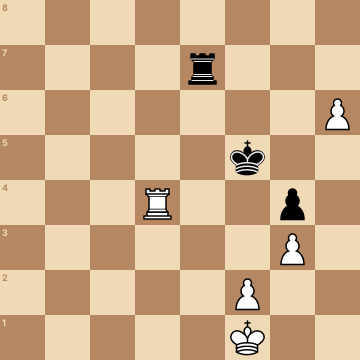
Rd8 was the last door — it closed shut.
I make him play on for another 80 moves, but he defends perfectly. Draw.
The kind of game where you do everything right for 50 moves, except the 3 that matter.
Takeaway: work on your endgames. The positions were winning; my clarity wasn't. This kind of lost half-point is recovered in training, not in tournaments.
Round 8 — The Kalashnikov Strikes
Date: Wednesday, July 30, 2026
Last round of the tournament. Across from me, a 15-year-old Portuguese player rated 1907 — on a tear, +200 points recently. The kind of player who doesn't yet know he's supposed to lose.
A Kalashnikov. I get a position I think is comfortable.
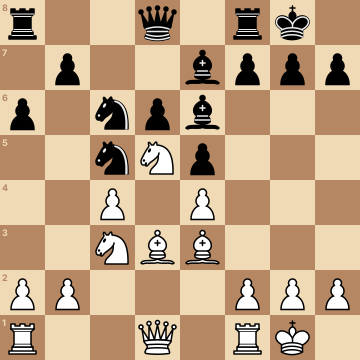
Comfortable position — or so I thought.
But he plays b4, which I'd completely underestimated. I play Bxd5 and he should have simply replied Nxd5 Nxd3 Qxd3 Bg5 with a good advantage. Fortunately, he goes wrong and captures my knight on c5.
He then sacrifices a pawn for activity. I think he misjudged Rxb7 Nb4 Nd5! Bd6 a3 Bc8 Rxb4! and White is winning.
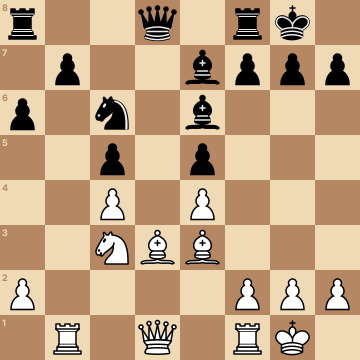
Pawn sacrifice — but the evaluation doesn't back it up.
He opts for Nd5 instead, and I reply with the very solid Nb4, thinking I'll grind him down with the bishop pair and the d4 square.
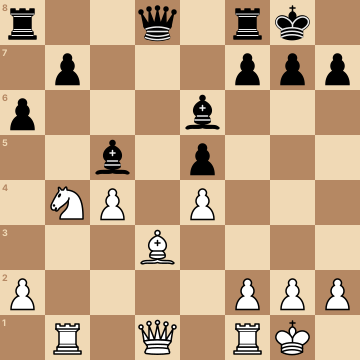
Nb4 — bishop pair, d4 square, and a clear plan: grind.
I go for the ambitious Qg5, trying to provoke errors on the kingside before simplifying to win the endgame. I manage to push him into an uncomfortable position.
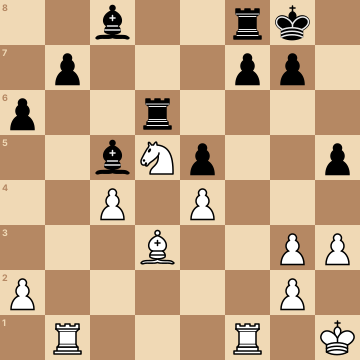
Mounting pressure — Black looks for a breakthrough.
I play solidly, and here I don't miss Bg4! which lets me simplify favorably — the bishop is untouchable thanks to a lovely back-rank mate.
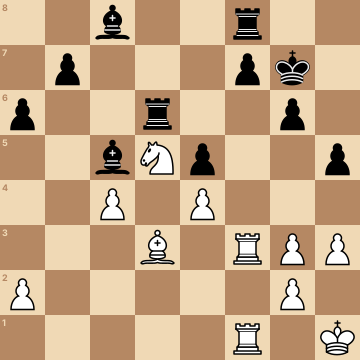
Bg4! — take it if you dare. Back-rank mate included.
Clarity starts to fade. Here, I don't dare play f5 — I tell myself I'll exchange pawns and target his e4 pawn by infiltrating my rook on the second rank.
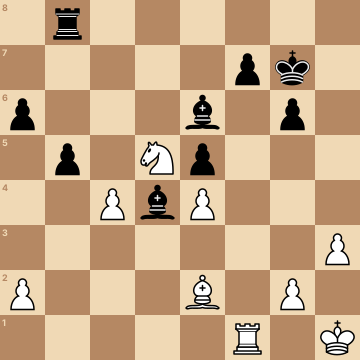
f5 was tempting — but caution wins out.
He doesn't sense the danger and opts for Nc7. I don't let the tactical shot slip:
Rxa6! Nxa6 Bc4
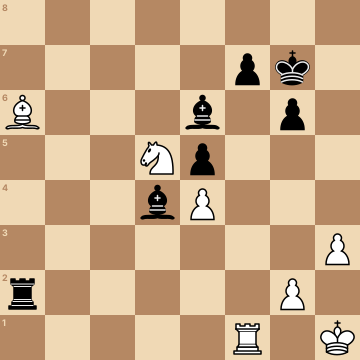
Rxa6! — the tactical blow that seals the game.
I convert technically from there. Victory.
Takeaway: against a young player on the rise, leave nothing to chance — and when the tactical shot is there, don't hesitate.
Round 9 — A Final Round Best Forgotten
Date: Wednesday, July 30, 2026 (afternoon)
Last round. I slept terribly and feel exhausted. Across from me, an American CM rated 2201. The kind of game where you need to be sharp — except my body has already handed in its resignation.
I blunder early with Ne3.
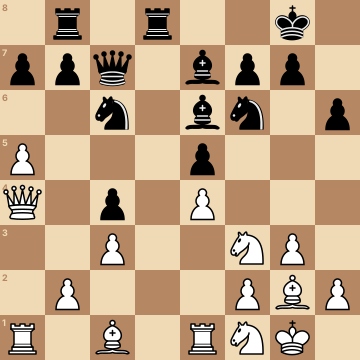
Ne3 — the kind of move you play when you haven't slept.
I choose to give up the queen rather than lose a pawn. The logic is simple: losing a pawn in this state means losing the game slowly. Giving up the queen means losing the game quickly — but at least you can hope for a fortress.
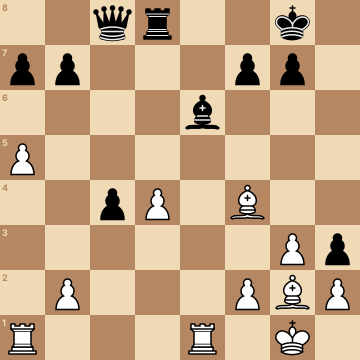
Without a queen — welcome to positional hell.
It's losing in every direction. But I have a tiny hope: he's about to play Bd5, which would let me find a fortress with Rxd5 and Bxh3 — if I get my bishop to c3 or trade c4 for b2, it's a draw. Unfortunately, he takes a break and finds g5.
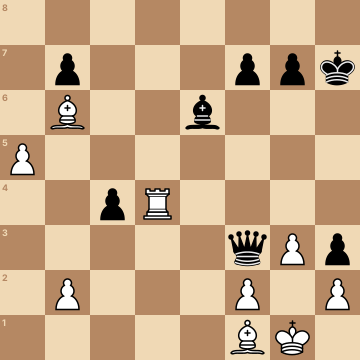
The fortress hope — gone up in smoke with g5.
He finds the beautiful maneuver Qg1 Bc7 Qg2 Ke1 Qg1 Kd2 Qb1 — my king is flushed out and h2 is going to fall.
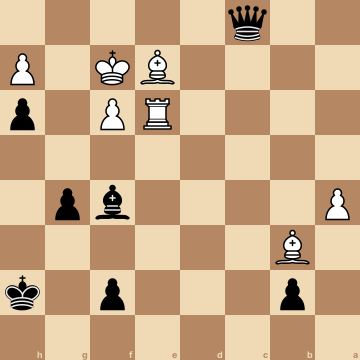
Qg1-Qg2-Qg1-Qb1 — elegant and unanswerable.
A final round best forgotten.
Takeaway: sleep. Just sleep.
Final Takeaways
Lessons Learned
4.5/9. Let's be honest: I'm disappointed. Not by the level of the opposition — the field was strong and I held my own against IMs and FMs — but by the points left on the table. A Round 4 wrecked by an excess of creativity, a Round 7 where the win slipped through my fingers, and two losses (R6, R9) where fatigue spoke louder than the board. With a bit more clarity in the key moments, this tournament could have been a 6/9. But "could have been" doesn't earn Elo points.
Here's what I'm taking home:
Stamina — this is THE project. The double rounds ate me alive. From Round 6 onward, my move quality drops with every game. I need to work on my physical fitness as much as my openings. Running, sleeping, eating properly — the kind of advice you give to others without ever following it yourself.
Endgames, endgames, endgames — Round 7 is a textbook case. Three missed wins in a single game. The positions were there, the technique wasn't. Program: one hour of endgames per week, minimum. Rook and pawns, bishop and pawns, the classics you think you know and rediscover at every tournament.
Fighting spirit vs. clarity — Rounds 4 and 8 tell two opposite stories. In R4, I think I'm Tal and wreck a winning position. In R8, I stay patient and convert cleanly. The lesson is clear: ambition, yes, but channeled. When the positional move wins, don't go looking for the sacrifice.
Trust your instinct — in R6, I see e5 and don't play it. In R7, I sense the win and hesitate. When intuition speaks, you have to listen — especially when the clock no longer leaves time to calculate.
Preparation pays off — Rounds 2 and 7 prove it. When I arrive with a 30-minute clock advantage thanks to prep, I'm a different player. That needs to become systematic.
Sleep — I'm only half joking. Round 9 is the direct consequence of a bad night. No sleep, no clarity, no result. It's as simple as that.
Final score: 4.5/9 — disappointing, but instructive. No time to dwell on it: I'm heading straight to Badalona. Rest will have to wait.
I didn't discover those six jobs in Pontevedra: they're the ones I get the players I coach to start on, with the small difference that they have someone holding them to it. If the list sounds familiar, it's roughly the programme we take apart together in adult chess lessons in Geneva.