
Tournament diary · · 27 min · By Alexandre Iwanesko
Swiss Team Championship: The Survival Weekend with Nyon
Rounds 6 and 7 of the Swiss top division with Nyon 1, 22–23 August 2026: two matches won 4½–3½, survival secured, both my games annotated.
In a nutshell: two top-division matches Nyon had no right to drop, both won 4½–3½, survival at the end of it — and a weekend that mostly taught me my problem isn't spotting the right plans, it's playing them.
Both games are replayable move by move at the foot of the page — one board, one button to switch from round 6 to round 7.
One convention for reading: a move actually played is written 20.Rc2, a move only calculated is written 23.g4.
The Setting: Two Matches to Stay Up
A word on what was at stake, because it colours everything that follows. Nyon 1 plays in LNA, the Swiss top division, and this weekend of August 22 and 23 brings rounds 6 and 7: Wollishofen 1 on Saturday, Echallens 1 on Sunday. Two teams within reach, and above all two direct rivals in the relegation fight: the points we take, we take off them in the same movement. Two six-pointers.
The captain does the maths for us before the first move, and it's short: win both and we're safe, season objective met, calculators away. Because behind that, the final LNA weekend falls squarely on the first two rounds of Nationale 1 in France. Part of the team will be several hundred kilometres from the playing hall, and we'll go into those rounds short-handed whatever happens. Better not to need them.
The standings live here: the SMM on swisschess.ch.
That leaves the team sheet. I play both days on board eight and I take Black both times — because Selvan is a monster with White. Our striker; our fox in the box, rather: hand him White and he brings the point back. So we lay the colours out to give him White, I double up on Black, and nobody argues. He'll go 2/2 in two gloriously messy games, the kind you watch over his shoulder between moves without understanding a thing, and walk away from telling yourself the result is deserved because it's there. Me, I'll go 0.5/2. We'll come back to that.
Round 6, Saturday — Wollishofen 1: Three Very Pleasant Hours, and a Fourth
Fourteen years old, 2313. Nineteen years younger than me, and by move six I'm already out of theory.
1.Nf3 Nf6 2.g3 g6 3.Bg2 Bg7 4.O-O O-O 5.d4 d6 6.Nc3: each of us fianchettoes his king's bishop and waits to see what the other does. And I push d5, that same d-pawn I moved one square the move before — twice the same pawn in six moves, on the scoresheet it looks like a typo. I do have a very down-to-earth reason: his knight sits on c3, so c4 is no longer available to him, the square is taken. He can't challenge my centre any more. I like that a lot.
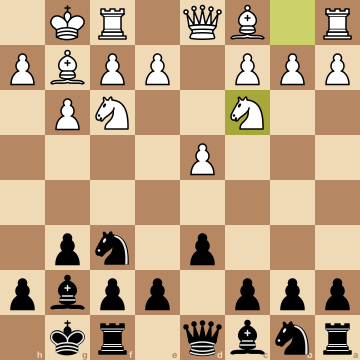
After 6.Nc3 — his knight has just condemned his own c-pawn to a sedentary life. c4 no longer exists, so I push d5.
7.a4 strikes me as slightly beside the point, and there I am having to choose a development. A setup with a5 must be perfectly playable, but no thank you: you manoeuvre for three hours and end up shaking hands. What I want is to challenge the centre with c5 — except that c5 right now doesn't work. First comes 7...b6, then Bb7, ideally with the knight coming to c6.
8.a5: a novelty, and a good move. In my database the only move played here is 8.Nb1, which doesn't look terribly good; the engine puts a5 on top at depth 30, and it's ruthlessly logical besides.
I put my setup together — 8...Bb7, then 9.Bf4 c5 — and my opponent thinks for a long time before playing 10.Bxb8?!. I find the move fairly bad. If you've read my other diaries, you already know my judgement of my opponents' moves is indexed directly to how comfortable I feel. The idea is readable enough: pick up the knight, then push a6 to shut my light-squared bishop in the corner. Only it can't work — the tension is already there on d4, my c5 pawn is leaning on it, and I'm the one who decides when the position opens. I recapture with 10...Rxb8 and I feel VERY good.
11.a6?! follows the idea to the end. Even a bad plan is better than no plan at all, said Chigorin; this one simply runs into the tension on d4.
Two squares for my bishop, Ba8 or Bc6. I hesitate briefly — briefly, because I'm not worried for a second: the tension on d4 lets me open the position whenever I feel like it and free my bishops. It'll be 11...Ba8, from where he'll follow the next nine moves from the balcony.
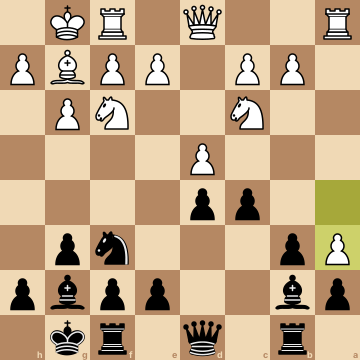
After 11.a6?! — my bishop goes to settle on a8. He'll stay there nine moves without ever looking worried.
12.e3 steadies his centre, and here comes the first real choice of the game. There's 12...b5, and after 13.dxc5 b4 14.Na4 a position I assess quickly: too sharp, next to everything else I have on hand. I take the pragmatic 12...Ne4, a small edge and easy to play. The kind of move you play at thirty-three and didn't play at twenty.
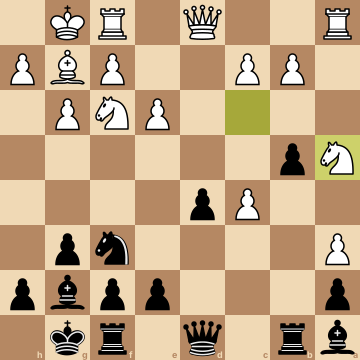
12…b5 13.dxc5 b4 14.Na4 — tempting, tense, and filed away in thirty seconds.
13.Nxe4 dxe4 14.Ng5 cxd4 15.exd4, and a second fork in the road, a far more interesting one. The match is going well — we're not far from leading, and you'll forgive the vagueness, it isn't very clear in my head either. I can take with 15...Qxd4, dead level, and coast towards a solid draw with opposite-coloured bishops. Or I can force him to be wildly creative to find any play at all. Knowing myself, and disliking crawling, I go concrete: 15...e5! A solid pawn in the centre, and my bishop pair finally breathing.
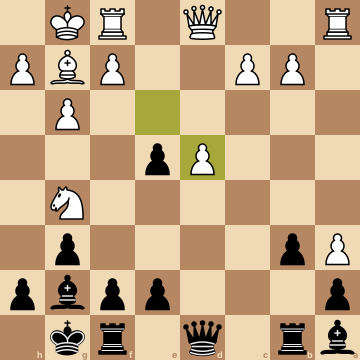
After 15.exd4 — Qxd4 and the flat opposite-bishops position, or e5 and we keep playing.
16.Nxe4 exd4: a passed pawn on d4, and a position I can't see White manoeuvring in. The engine leaves him one move to equalise, 17.c4.
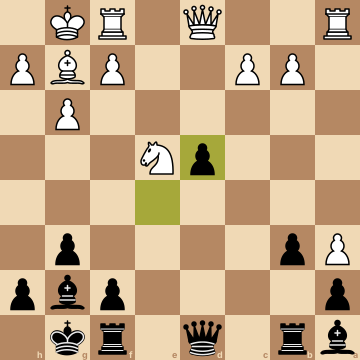
After 16…exd4 — a passer on d4, and exactly one move to equalise: 17.c4. He won't play it.
He doesn't play c4. He plays 17.h4!, and fast. These youngsters were raised on engines and it shows: shoving a rook's pawn up the board in front of their own king doesn't cost them a second's hesitation, and they shove it at the right moment. That pawn, I'd have left at home. Then comes 18.Qd3: his queen as a blockader in front of my passed pawn. Using your queen for that is putting a surgeon on car-park duty.
A few normal moves, and we arrive here.
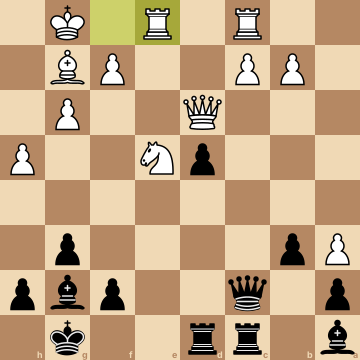
After 20.Rfe1 — the dream position. Except the a8 bishop, still on holiday.
Nearly all my pieces are well placed; the one cutting a sorry figure is my light-squared bishop, still in his corner on a8, where he's been waiting nine moves for somebody to deal with him. I look for an improvement and I find the square that would suit him perfectly: c4. Hence 20...Bd5!, with the idea behind it: if he plays 21.Nd2 to deny me c4, I trade with 21...Bxg2 22.Kxg2 and drop in 22...Bh6!, which forces 23.f4 and weakens his king for the rest of the game.
He plays all of it. Nine moves to work out what to do with that bishop, and he ends up traded — but not before forcing f4.
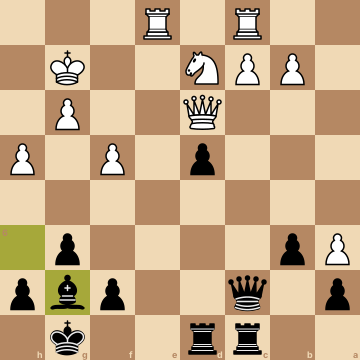
After 23…Bg7 — bad piece traded, f4 forced. Two weaknesses left: c2 and a6.
So my bad piece is gone and his king is weakened. That leaves his two weaknesses, c2 and a6. The plan writes itself: queen to c6, then b5 to clear the sixth rank, and I get to eat that presumptuous a6 pawn.
24.Nf3 Qc6.
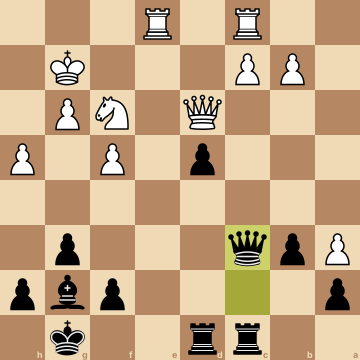
After 24…Qc6 — the queen is in place; all that's missing is b5 to open the rank onto a6.
Here we both rule out 25.Re7 because of 25...Re8 26.Rxa7 Re3, which wins very quickly. The engine, for its part, holds the position level after 26.Rce1 Qxc2 27.Qxc2 Rxc2 28.Kh3 Rxe7 29.Rxe7 Rxb2 30.Rxa7 Bf6. Two humans agreeing with each other and a machine agreeing with neither: the usual scene. Worth noting that against 25.Re7 I also had 25...Rc7, which left me pressing without the slightest risk — trading a pair of rooks does nothing to reduce the pressure on c2 and a6.
He goes wrong with 25.Qe4, and I answer 25...Qb5!. He defends with 26.b3, and here comes the most important moment of the game — the one I probably wouldn't have handled the same way in an open.
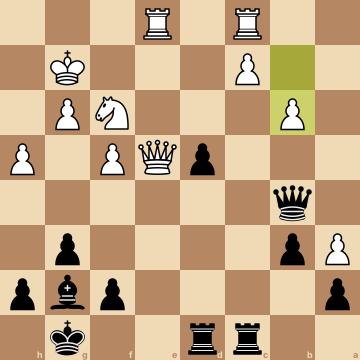
After 26.b3 — 2½–0½ in the match, four games still running. Not the moment to play the hero.
The match stands at 2½–0½ to us, four games still running, and the balance is even: one of ours slightly worse, another slightly better, the rest level. Translation: I'm not allowed to take a risk. In an open I wouldn't have done that arithmetic — in an open, nobody counts the points on your behalf.
I look at 26...Qxa6, and after 27.Ra1 I already feel less comfortable: his pieces are starting to play. I look at 26...Rc3, and I'm not thrilled at the sight of him activating with 27.Ne5. Then I see the simple 26...d3: small edge kept, zero risk. I feel good enough to start making choices that, in hindsight, deserve an inquiry. We each have about twenty minutes.
27.cxd3 Qxa6: the a6 pawn, the one that was going to shut my bishop in and ended up shutting nobody in, finally falls. 28.Rxc8 Qxc8.
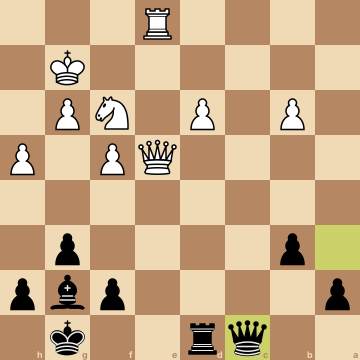
After 28…Qxc8 — fragile white king, black majority on the queenside, and a g7 bishop pushing it from behind.
Everything is going to plan. Which, in a game of chess, is generally the beginning of a problem. If he wants to block with d4, he hands me an easy target. He plays 29.d4 and I choose the active 29...Qc3: I'd rather let him weaken himself before advancing my majority. It's probably imprecise — my pieces are already well placed, I should have pushed my pawns.
30.Re3 Qb2+ 31.Kh3 Qf2.
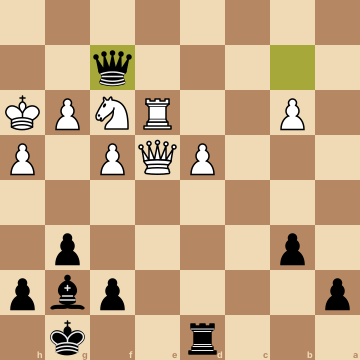
After 31…Qf2 — his king is out in the open on h3, and I can already see myself winning.
His king has ended up on h3, exposed. My opponent, for his part, wants absolutely nothing to do with a draw. I play on that, and I push it a little. At this stage, pushing it is still an excellent idea.
32.Qd3 h5 33.Re7.
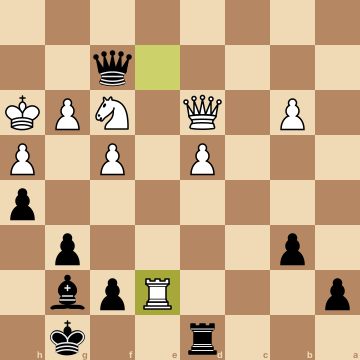
After 33.Re7 — he cracks. The c-file is mine.
He cracks. 33...Rc8! finally takes the open file and forces him back. Either he trades queens with 34.Qe2 and I inherit a very pleasant endgame, or…
34.Re2 Qf1+ 35.Kh2.
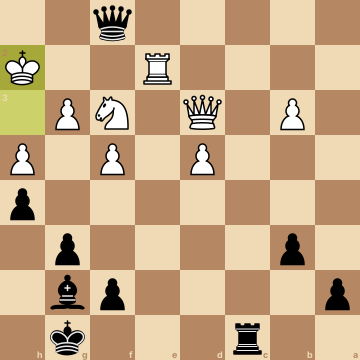
After 35.Kh2 — Rc1 fails to Re8, and there the queen trade would leave my pieces scattered.
35...Rc1 doesn't work, because of 36.Re8: this time the queen trade leaves my pieces without a shred of coordination. I find 35...Bf8!, which improves my bishop, covers the tactics, keeps the b4 square available to him, and supports the march of my queenside pawns. One of those moves that give you the feeling you have the game under control. He has four minutes, I have ten, and I can already see the finish. It will of course be different from the one you're imagining.
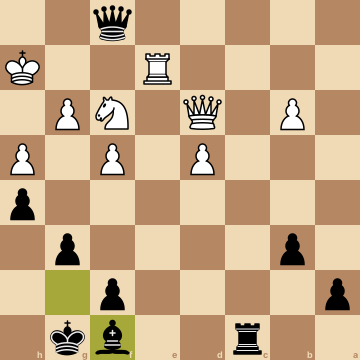
After 35…Bf8 — the bishop is perfect, the game is won, all is well. Which is exactly the moment I choose to want too much.
A shortage of clear thinking and his excellent defensive eye are about to make very poor company. I have a winning position, ten minutes more on the clock and no reason to complicate. So naturally, I complicate.
I want to mate him. I want it too much. Trading queens, playing Bb4, then Rc2, then advancing my majority is enough to win — my bishop would be a perfect blockader on d6. A clean win, slow, final. Instead of sitting quietly on it, I want more and I play the dubious 36...Qa1.
37.Rd1 Qb2+ 38.Rd2 Qa1 39.Kg2. We start the fourth hour.
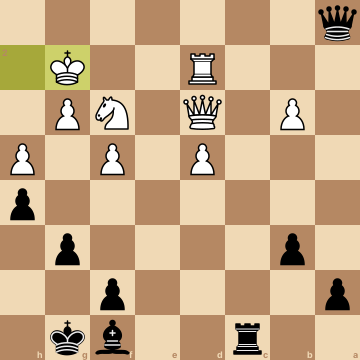
After 39.Kg2 — Rc3 gives nothing concrete, so I improve the bishop.
I look at 39...Rc3, and I see nothing concrete after 40.Qe4 Rxb3 41.f5 — I even feel in danger. So I play 39...Bb4, to improve the piece. He answers 40.Rf2 with a handful of seconds.
I have six minutes left to make my fortieth move.
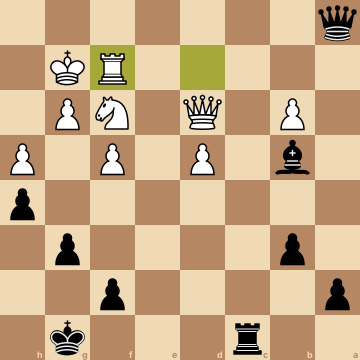
After 40.Rf2 — six minutes on the clock and a single square in my head.
40...Rc3 41.Qb5 looks messy to me. 40...Qc3 41.Qb5 too. 40...Rc1 leads nowhere. You'll have spotted the common factor: I have tunnel vision on Qb5, one square, as though the rest of the board had been unplugged. I play 40...a6, threatening to finish the job by coming into c3.
Five minutes fifty-five of thought to push that pawn, then a little stroll to savour the discovery.
I come back.
41.f5!
Ah.
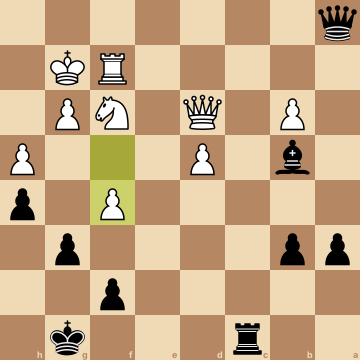
After 41.f5! — five minutes to play a6, thirty seconds outside to forget his pawn existed.
My position falls apart. My king is horribly weak. I take fifteen minutes looking for a chance, and settle on 41...Qc3 42.Qxa6 gxf5, with the idea 43.Qb5 Qxb3 44.Qxf5 Qe6 45.Qxh5: a position that isn't so easy to convert.
He takes the other pawn — 43.Qxb6 Qxb3.
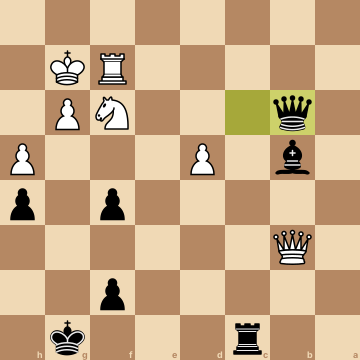
After 43…Qxb3 — he's about to go wrong. And I'm about to stop believing.
He goes wrong with 44.Qh6. And another of my demons wakes up: I no longer believe in my position, I think I'm done for. I could play 44...Rc2 45.Qg5+ Kf8 46.Qxf5 Rxf2+ 47.Kxf2 Bd6! — not so simple for him — and hope to hold, because his king is very weak.
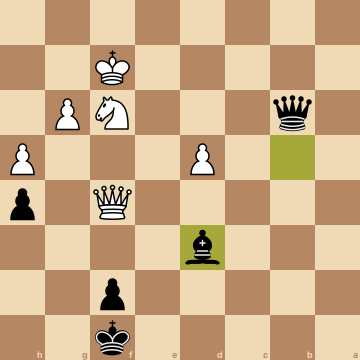
The line I don't play: 44…Rc2 45.Qg5+ Kf8 46.Qxf5 Rxf2+ 47.Kxf2 Bd6! His king is very weak.
I don't believe in it, so I stop fighting. I centralise my queen — the move of a man tidying his desk. It isn't a chess decision, it's an elegant way of admitting I've run out of ideas.
44...Qd5 45.Qg5+ Kf8 46.Qxh5 Kg7 47.Qg5+ Kf8: here I see 48.Re2 and I'm a hair away from resigning. He goes for 48.Qh5, I reply 48...Kg7, he plays 49.Kh2? — and I find 49...f6!!.
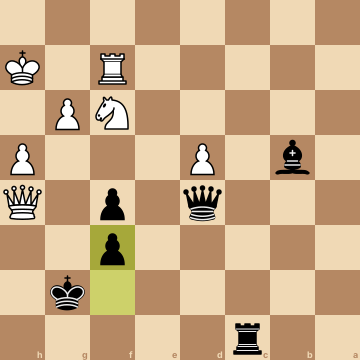
After 49…f6!! — Ne5 doesn't work, and Rh8 quietly traps the white queen.
50.Ne5 doesn't function: 50...fxe5 51.Qg5+ Kh8 52.Qf5 Rf8!! and I ought to be able to hold that ending. I'm also quietly threatening Rh8, which shuts his queen in. He picks the very human 50.g4.
And I need a check.
I have two to hand. I play 50...Qd6+.
It had to be 50...Bd6+. The difference is one square, and it's mine: as long as my queen stays on d5, she covers f5. The bishop gives the same check without leaving the guarding square — and it gives a good deal more than that. Against 51.Kh3, I drop in 51...Rc2!! and he's the one who has to be accurate to hold. Against 51.Kg2, it's 51...Rh8 52.Qxf5 Qxf5 53.gxf5, and there 53...Rh5! wins a pawn back and leaves me a tenable ending.
That Rh5, I don't see. So I take my queen off d5 for a check that earns nothing, and two moves later his queen settles on exactly the square mine was watching — 52.Qf5. There's nothing left to negotiate.
And the same demon as on move forty-four comes back, heavier. The moment I feel finished, I stop competing. It isn't that my calculation goes wrong at that point: it's that I've already decided there's nothing to find, so I stop looking. 52...Ra8 53.h5 Ra5 54.Qg6+ Kh8 55.Re2 Ra8 56.h6 Rg8 57.Re8 — five moves played by a man who has already put his scoresheet away in his head. I hold out my hand after Re8. 1-0.
Four hours to build a winning position, throw it out of the window, get it back twice, then throw it away for good. A fairly full day's work.
Nyon 1 – Wollishofen 1: 4½–3½. The team gets there without me, and that isn't a polite formula: that day, my point was brought back by somebody else. There's another to go and fetch tomorrow.
I didn't lose that game because he played better. I lost it because winning it cleanly wasn't enough for me.
Round 7, Sunday — Echallens 1: Lost Twice, Never Lost
In this round, the variations in the text are the ones I calculated at the board, with what I believed at the time. The grey boxes are the engine's verdict, delivered cold. It wasn't kind.
Across the board, 2118. Me, 2150. Thirty-two points between us, which is to say nothing — except that a split doesn't help the team. Four hours of chess yesterday, and we go again today.
1.Nf3 Nf6 2.c4 g6 3.b3 Bg7 4.Bb2 O-O 5.g3 c5 6.Bg2 d6 7.d4 d5 8.O-O: so far, I know this.
I take the simple line, 8...cxd4. The other one, 8...dxc4 9.bxc4 cxd4 10.Nxd4 Nc6 11.Nxc6 bxc6 12.Bxc6, I vaguely remember: there's 12...Bh3, a rook sliding from c8 to c5, and a key move somewhere involving Nd7. "Vaguely" is the word. And on 12.Qxd8 Rxd8 13.Bxc6, I'm not sure about my compensation. So, the simple line.
9.cxd5 Qxd5 10.Qxd4 Qh5 — against 10.Nxd4 Qh5 I'd have felt very comfortable. 11.Na3 Nc6, played a touch too quickly: I think I prefer Bh3.
12.Qh4.
That move depresses me. We're heading for a queenless, fairly symmetrical position I have no confidence in, and I recapture with 12...Qxh4 with the enthusiasm of a taxpayer. 12...Qxh4 13.Nxh4 Bg4 14.Bxc6 bxc6 — at the time I think 14.Bxc6 is wrong, because I have no trouble activating. That c6 weakness will stick to me until the last move of the game.
15.f3 Be6 16.Rfc1. My first idea is 16...a5, and I spend a while on it: 17.Rxc6 a4 18.b4 Rfb8 19.b5 and White looks better to me, while 18.bxa4 Rxa4 looks entirely level — I can't see how he improves without dropping a2. What I don't see in any of that is 19...Bd7. I play 16...Rac8.
17.Ng2! — good move. 17...Bh6 18.Rc5 Rfd8 19.Kf2 Rd5 20.Rc2.
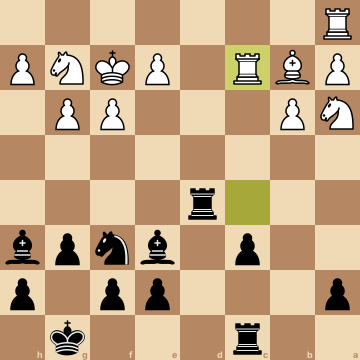
After 20.Rc2 — roughly the most I can hope for. And no idea what to do with it.
I'm at roughly the most I can get, and I don't know what to do. My brain goes off for a literal walk.
20...Rh5: I tell myself I'm pleased to weaken g3 and give my knight some play. 21.h4 Rf5 22.Ke1. Three rook moves to make him advance a pawn one square: I've signed better contracts. And in the end he's the one who improved, not me. 22...Rd5 23.Nc4.
And I play 23...Rb5.
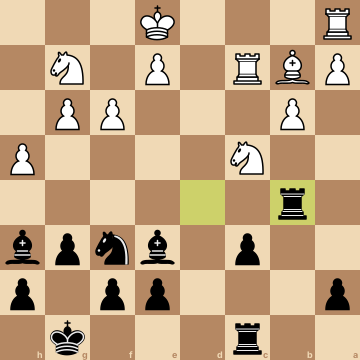
After 23…Rb5 — Bxf6 and then Nd6 wins. The whole hall sees it. Except one person.
I get up perfectly calmly, and see with horror 24.Bxf6 followed by 25.Nd6. I also see my teammate Murtez, a master from Kosovo with an unusually expressive face, aiming enormous eyes at me. My only fear at that instant is no longer losing: it's that he catches my opponent's eye and my opponent understands. Every single person walking past the table seems to see this childish tactic. All that's left for me is not to look like a man who has just discovered he's probably lost.
He thinks for fifteen minutes. Fifteen minutes during which my only job is to pretend I don't know that Bxf6 wins.
24.e4.
The engine, after the fact
It confirms what I saw standing up: 24.Bxf6 exf6 25.Nd6 was winning. And it adds that two moves earlier, 23.g4! was already clearly stronger than 23.Nc4.
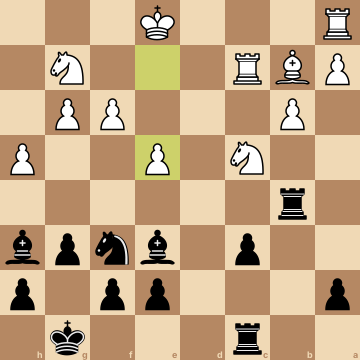
After 24.e4 — fifteen minutes of thought in order not to play Bxf6. I sit down and breathe.
I take a few minutes to gather myself.
24...Nd7: I defend e5, and I want to activate at all costs with f5. 25.Nge3 — my position still isn't much to look at. 25...f5 26.exf5 gxf5 27.f4! My bishops cut sorry figures, but at least I haven't lost.
27...Kf7 — the idea is to activate with Rg8. 28.Rac1 Ke8 29.Na3, which I miss completely.
The engine, after the fact
28...Rg8 held: 29.Kf2 Bg7 30.Bxg7 Kxg7 31.Na3 Ra5, and the position is equal.
I wanted to play it, and I didn't. There's no better summary of my day.
29...Rb6 30.Bd4 Ra6 31.Nb5!
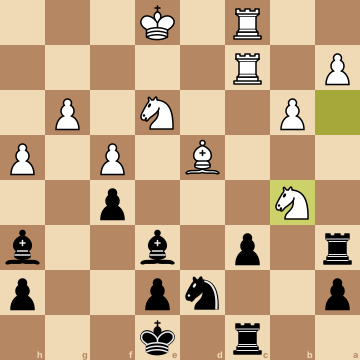
After 31.Nb5! — he has two minutes, I have ten. The best move is no longer the point.
My opponent is in time trouble: a couple of minutes against ten or so for me. And he doesn't strike me as especially sharp in tactical positions. So I change jobs. I'm no longer a chess player, I'm a manufacturer of problems. The specification is simple: every move has to cost him time.
31...c5, because 31...cxb5 32.Rxc8+ Kf7 33.R1c6 Rxa2 34.Rxe6 is hopeless. 32.Bxc5 Ra5!?
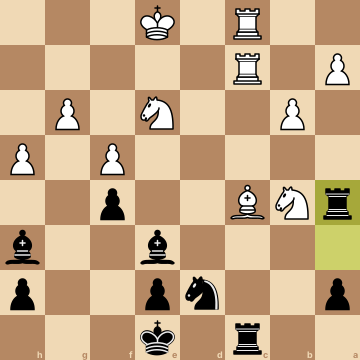
After 32…Ra5!? — not the best move in the world, just the most unpleasant one to handle in two minutes.
Poisonous, and that's all I'm asking of it. Objectively it probably isn't the best move in the position; it's simply the one I wouldn't like to be handed with two minutes on my clock. The clean line, 32...Nxc5 33.Rxc5 Rxc5 34.Rxc5 Rxa2 35.Nc7+ Kf7 36.Nxe6 Kxe6 37.Rc6+ Kf7 38.Rxh6, ends on that damned bishop.
The engine, after the fact
33.Nd4! won on the spot. 33.a4? lets everything slip.
33.a4? Two minutes on the clock, and he picks the one plan that gives me my pawns back. There's a future in this trade. 33...Bxb3 34.Rc3 Bxa4. 34...Rxc5 35.Rxc5 Nxc5 36.Rxc5 Rxa4 must be more interesting — missed entirely.
35.Bb4 Rxc3 36.Nxc3 Ra6 37.Nxf5, the simplest. Against 37.Ra1, I had 37...Bb5: the point I'd seen when I played c5.
37...Bf8 38.Nd5 Kf7 39.Bxe7 Ke6. I try the swindle: with his handful of seconds, I can't see him finding Nfe3, which reinforces the threat of Nc7. The honest line, 39...Bxe7 40.Ndxe7 Re6+ 41.Kf2 Rxe7 42.Nxe7 Kxe7 43.Ra1 Nc5, looked genuinely hard to play: his kingside majority is too strong, it's the classic position where the rook dominates the two minor pieces. If my a7 pawn had been on g6, that's clearly where I'd have made the draw.
The engine, after the fact
There was better, in the same spirit: 39...Ra5! — 40.Nd6+ Ke6 41.Bxf8 Rxd5 42.Ne4 Nxf8 43.Nc5+, and after 42...Kf5 43.Nc3 Rd3 44.Nxa4 Nxf8 45.Kf2 Kg4 there are still practical chances.
With his thirty seconds, I think Ra5 was winning on the spot, purely by making him panic. I chose the swindle next door.
40.Bxf8 Kxd5?! I thought that knight was the more dangerous of the two. With a clear head, I regret it: it was 40...Kxf5, and after 41.Ne3+ Ke4 I'm the one winning.
41.Bb4!
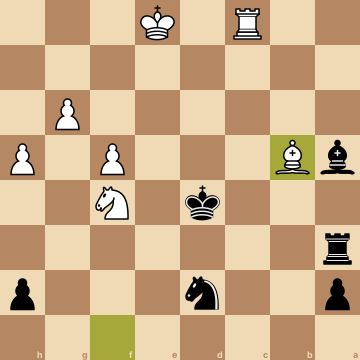
After 41.Bb4! — time trouble over, and my pieces barely know each other.
My position is uncomfortable, my pieces have no coordination and I'm running on empty. I calculate 41...Ke4 42.Nd6+ Kf3 43.Rc3+ Kg4, which I reject because I can't see how to untangle my pieces after 44.Ra3. I calculate 41...Bb5 42.Rd1+ Kc4 43.Bd6, which looks genuinely hard.
And I play 41...h5. That move is atrocious.
42.Ke2 — very, very good, and not easy to find. My main idea was 42.Ng7 Ke4 43.Nxh5 Kf3.
42...Nf6.
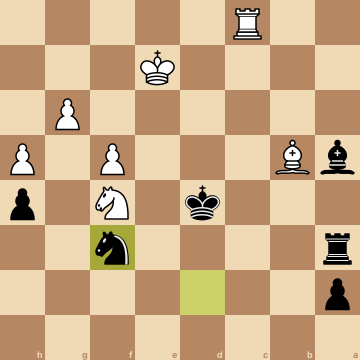
After 42…Nf6 — the one line where I drop a rook that I hadn't calculated.
I'd spent a long while ruling out lines where I lost a rook to a fork. I find a brand new one. 43.Rc5+! — and against 43...Ke4, 44.Re5 is mate.
43...Ke6 44.Re5+ Kf7 45.Nd6+. Exactly the kind of position where my brain does whatever it likes: I hesitate over 45...Kf8, telling myself he has no good discovery, when the automatic move must be Kg8.
The engine, after the fact
45...Kf8 lost to 46.Re6. And even after 46.Ne4+ Kf7 47.Rf5, I had to find 47...Re6!! — 47...Bc2 runs into 48.Ng5+!.
For once the hesitation ended on the right side. 45...Kg6 46.Rg5+ Kh7 — against 46...Kh6 47.Nf7+, it's over. And the whole time what I'm really hoping for is 45.Re7+ Kg6 46.Rg7+ Kxf5, where he'd think it was mate and forget his piece entirely.
47.Kd3. To win with this setup, he has to put his bishop on c3. 47...Bb3: I take the chance to activate the bishop and defend f5 by getting onto the b1-h7 diagonal. 48.Nf5 Ba2 49.Kc2 Bd5 50.Kd3 Ba2 51.Bc3 Bb1+.
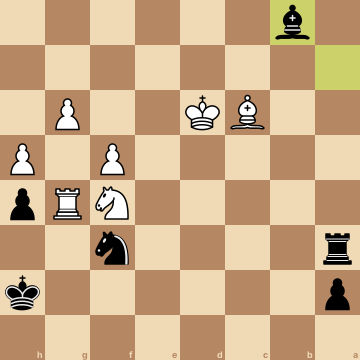
After 51…Bb1+ — my knight has been waiting for e4 for ten moves. All that's missing is his king.
My knight has sat on f6 since move forty-two and it wants one square: e4, from where a single hop hits c3 and g5. His bishop has just parked itself on c3 unprompted. His rook has been on g5 for five moves. All that's missing is his king.
52.Kc4.
There he is.
Relief, the second of the day. Against 52.Kd4 Re6 I was building roughly a fortress; here I don't even need one, and I don't miss the chance: 52...Rc6+ 53.Kb3 Rxc3+ 54.Kxc3 Ne4+ — the fork, king and rook — 55.Kb2 Nxg5 56.Kxb1 Ne4.
He took my rook and my bishop, I took his bishop and his rook: everything left through the same door. That leaves his knight and three pawns against my knight and two, a passed a-pawn on my side, a kingside majority on his, and exactly enough not to win on either side. ½–½.
Two blunders, two pardons, fifteen minutes of opponent's thought at the right moment and a king that goes for a walk to c4. That half point, I didn't earn: I was handed it.
Nyon 1 – Echallens 1: 4½–3½. Survival secured, objective met.
And the real difference from the day before fits in one line. On Saturday, I stopped fighting before the game was over. On Sunday, I was objectively in serious trouble twice, and I kept asking him questions right to the end — c5, Ra5!?, Ke6, Bb3. It wasn't my calculation that brought back that half point.
The Weekend at a Glance
Two matches, twice by the narrowest of margins, and survival at the end of it. Selvan 2/2, me 0.5/2 — in two matches decided by half a point, both numbers weigh exactly the same.
What I Take Away
Deep down, this weekend doesn't leave me feeling I need to learn to judge positions better. My judgement is something I'm starting to trust: often enough, I see what I want to get, where the weaknesses are, which pieces have to move.
The trouble starts immediately afterwards. You have to calculate.
Believing a position is good isn't enough. You need the confidence to play the line you've found, to check right to the end that it works, and to accept that a complicated position doesn't necessarily call for finding something more reassuring.
Too often I've replaced calculation with an impression: "this must be good", "this must be dangerous", "that line looks safer". And when the position turned concrete, I found myself doubting what I had assessed correctly a few moves earlier. On Saturday I'd found the plan that won — trade queens, Bb4, Rc2, the majority rolling — and I didn't play it. On Sunday I wanted to play Rg8, and I didn't play that either.
So the next step is simple enough to state, even if it will probably be less simple to apply: know my lines better, calculate my variations better, and above all trust the positions I've actually calculated.
And perhaps also believe a little longer that the game is playable. At Badalona, several positions I thought were lost weren't; several positions I thought were winning weren't either. In both cases it wasn't my judgement that failed me: it was the calculation that was supposed to confirm it.
That's the main lesson I bring home from the weekend. The most important thing is left, and it has nothing to do with my two games: Nyon 1 stay up in LNA. That was the objective of the season, we met it in two matches, and I'm genuinely glad to have been part of it — even for half a point.
Seeing the right plan and not playing it isn't a knowledge problem, it's a training problem. If that happens to you too, it's precisely the gap we measure and close in adult chess lessons in Geneva.
Both Games, Move by Move
Jan Saminskij – Alexandre Iwanesko
Championnat suisse par équipes (CSE) · round 6 · 1-0
Jan Saminskij2313
Alexandre Iwanesko
0/113