
Tournament diary · · 22 min · By Alexandre Iwanesko
Monthey Grand Prix 2026: diary of a very strong open
Diary of the 15th Monthey Grand Prix, 4–6 September 2026: three rapid rounds on the Friday evening, four classical games over the weekend.
In a nutshell: seven rounds in three days at Monthey, three rapid games on the Friday evening and four classical ones over the weekend, in a frighteningly stacked open — and a tournament that showed me fairly precisely where my calculation stops.
A reading convention: a move played in the game is written 20.Rc2, a move only calculated is written 23.g4.
The setting: two time controls, one tournament
A good chunk of the Swiss calendar runs on this model, and I have several more of the same kind ahead of me. Friday evening, you sit down three times in a row for 20 minutes + 5 seconds, three rounds dispatched between dinner and 11pm. Saturday and Sunday the hall turns serious, you move to 90 minutes + 30 seconds a move, and you play the last four. Seven games, three days, and honestly two different sports.
What isn't ordinary at Monthey is the entry list. The tournament is stacked — not in the sense that a few grandmasters drop by to say hello, but in the sense that there is no breathing room as you go down the table. Christian Bauer (2587), Nikita Petrov (2564), Alexandre Dgebuadze (2460), IM Tom Decuigniere (2431) and Joseph Gallagher (2393) at the top, FM Aurelio Colmenares (2303) right behind, then a pile of 22s — Romain Gemelli, Steve Papaux, WIM Mariia Manko — not counting CM Fernandes Barbosa Dos Santos and FM Or Shatil a little further down. Eighteen players above 2000 out of seventy-five entries.
With my 2245 I'm the seventh seed, and that number protects me from nothing: the top boards are spoken for and everything hangs on half a point.
One clarification that matters for everything below: the pairings were made on rapid ratings, the four classical games included. Every Elo you'll read here comes from the rapid list — mine says 2245, my classical list says 2128. We'll do the sums properly at the very bottom.
Mostly I come to Monthey with the sentence I brought back from the Swiss Team Championship three weeks earlier: my judgement is roughly fine, it's my calculation that lags. I thought that was behind me.
For the three rapid games my plan fits in two words: fast and practical. No line to reconstruct move for move, no position where only one move will do. And no equal position scares me that evening: if it takes forty moves of pushing wood to turn half a point into a whole one, I'll push.
Round 1 — Friday 4 September, Black against Amael Farine (1743)
Across the board, a young player who plays very solidly. No adventure, no complication: he wants to trade. One pair of pieces, then a second, then a third, with the diligence of a man tidying his garage.
Except he's carrying a weakness on e5, and every trade makes it a little harder to hold: one piece fewer on the board is one defender fewer for that pawn. I let him get on with it.
At the end of his big clear-out, I take e5. Then everything else goes out through the same door and what's left is a rook endgame a pawn up, which I convert without needing to be clever.
Round 2 — Friday 4 September, White against Max Chappaz (1906)
A young Valais prospect, and a French Fort Knox: Black brings the light-squared bishop out via d7 then c6, trades it off, and settles into a position without a single hole. Nothing to attack, nothing to grab.
Except we've already sat across from each other, he and I, at Martigny a year ago, in this exact line. He didn't come back empty-handed: he's done his homework, and he improves his move along the way.
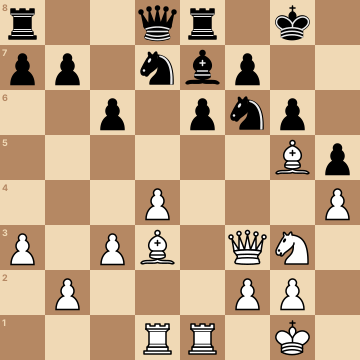
One combination, two ways in. The order is what decides.
There's a demolition on the board, and it can be written two ways: Bxg6 fxg6 Rxe6, or Rxe6 fxe6 Bxg6. The same two captures, the same king cover blown open — except that from one order to the other it isn't the same pawn recapturing, so not the same files and not the same continuation.
I count once. I count again. I can't make up my mind — not because it doesn't work, but because I don't know which of the two works better.
So I don't decide, and I play Rd2. Nothing taken, nothing disturbed either: the bishop stays on d3, the rook stays on e1, the demolition is still there. Over to him to find the moves that stop it.
The endgame arrives on my side and I convert it.
Round 3 — Friday 4 September, Black against Flavio Rotunno (2031)
Rotunno, a dangerous young Swiss, and the 2031 on the table is a mirage: it's a rapid rating, and he almost never plays rapid. At classical he's 2150, twenty-two points above me, with a peak around 2280 that's about the same as mine.
He has White and he picks a very equal line. Not equal in the "chances for both sides" sense: equal in the sense that the pieces stare at each other and the draw is written into the position before we've started.
So I hand him the bishop pair. It isn't the soundest choice and I know it as I play it — no engine will put it top of the list. It's a practical choice: at this time control, an equal position where my pieces have work to do beats an equal position where nobody has anything to do.
And he charges. With the bishop pair and a position he believes is better, he plays actively where there was nothing to go and get. I have nothing spectacular to do: I counter, and we both end up in front of a position that has to be calculated.
Three weeks earlier, in the team event, I had found the right plans and hadn't played them for want of checking them through. This time the line looks clear to me. I calculate it. I play it.
The engine, after the fact
Clear and correct. For once the machine agreed with me before I put the piece down.
An endgame, forty moves of grinding, the point.
3/3. It's 11pm, the hall is emptying, and I haven't pushed a single pawn at 90 minutes yet.
Round 4 — Saturday 5 September, White against GM Nikita Petrov (2564)
Friday evening, home again, I open the laptop to prepare. I type his name, I scroll through his games: draw against Sindarov, draw against Carlsen. I close the laptop and go to bed.
Board 2, and a player like that I meet three times a year in a good year. I turn up with 3/3, a full night's sleep and no preparation at all.
Which doesn't stop me playing my first moves with the air of a man who knows exactly what he's doing: I believe this position has been filed away in my notes for years. It hasn't. I work that out roughly a move and a half later.
Then he plays a move I don't know, and I run the reasoning we've all run at least once: I don't know this move, so it isn't in my files, so it can't be much good, so I must be better. Three "so"s and not one variation.
13.Qh3 pleases me: the queen eyes the f4-f5 push as much as Bh6, there's finally something to do. He answers d5, I put in f3, and I stop to look at what the two of us have built.
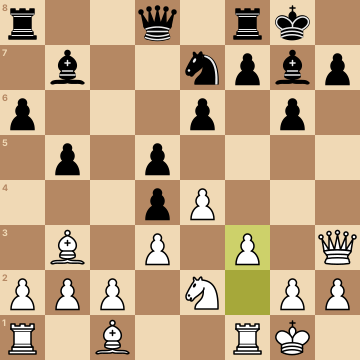
Three and a half bad bishops on the board. I'll let you decide which one only counts for half.
Mine on b3 stares at a wall of pawns, his b7 bishop stares at mine, the one on g7 is waiting for a centre that will never open — and my c1 bishop retains a vague reason to exist, hence the half.
And I have a dream at that moment. If he finds nothing very active on the queenside, I play Bh6, then h4, h5, Kf2, Rh1, and I mate him. In five announced moves, against a 2564.
14...a5 ! He finds something very active on the queenside. The dream will have lasted a move and a half, which is still generous for a mate announced against a grandmaster.
15.a4 bxa4 16.Bxa4 Bc6 17.Bh6 Bxa4 18.Bxg7 Kxg7 19.Rxa4 Rc8 ! 20.Rc1.
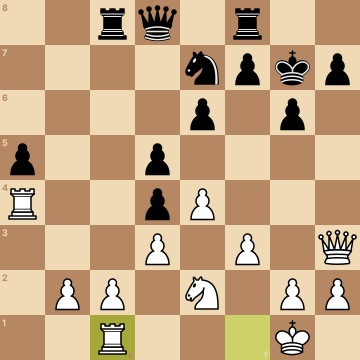
Objectively he's better. All that's left is to squeeze me without a single inaccuracy.
I take stock. My queenside is flimsy, my attack no longer exists, but his d4 and a5 pawns aren't pretty either, and at the first inaccuracy I take d4 or I simplify with c3. Mostly I spend a lot of energy convincing myself that Black isn't winning here. That isn't quite the same as believing it.
20...Nc6 ! He's wearing me out. He is VERY precise — every move shuts a door, and he never fidgets. There I am, waiting for an inaccuracy from someone whose job it evidently is not to commit any. I drink a lot of water.
21.Qg3 ! e5, again the most annoying move: it cuts across my ideas. I briefly consider taking on d5 and I put the idea back down when I see Nb4-d5-e3 coming.
The engine, after the fact
The capture I put back down without calculating held the position: 21.exd5 Qxd5 22.Qh4, and it's equal. I replaced a calculation with an impression.
22.Rca1 ! Re8 ! 23.c3 ! Rb8 24.R4a2 Rb3 !?
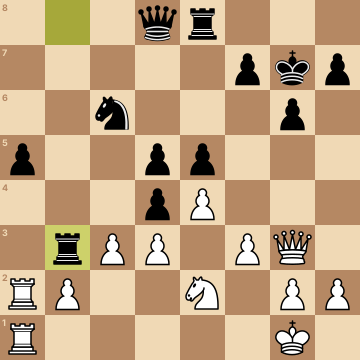
24…Rb3 — that one I hadn't seriously considered.
I had it in the back of my mind that Nc1 would come and defend d3 when the time came. I never got past the back of my mind.
25.Qf2. I set off down the hot line, with a firmly settled conviction: he can't take on d3 without me turning it around on him. 25...dxc3 26.bxc3 dxe4 27.fxe4 Qxd3 !
A 2564 is not afraid of my convictions.
28.Rf1 Qd7 29.Rd2 ! Qe7 30.Rd6 ! Rc8 ! 31.Rf6. Every one of my pieces is looking at f7, his aren't talking to each other, we have two or three minutes each, and a very distinct little voice asks whether this is match point. Against a 2564 that voice ought to set off an alarm. It set off a smile instead.
31...Nd8 32.Qh4 Rb7 33.Ng3 Kg8 34.Qg4 ! — I attack the rook and put the queen on its best square.
34...Rxc3 35.Nf5 ??
I play it with the poise of a man who has seen everything. 35.h4 was better. What I had actually seen was four moves further on, and one very precise position I wanted to reach.
35...Qc5+ 36.Kh1 Rc1 37.Nh6+ Kf8 38.Qh4 Rbb1 39.Rxf7+
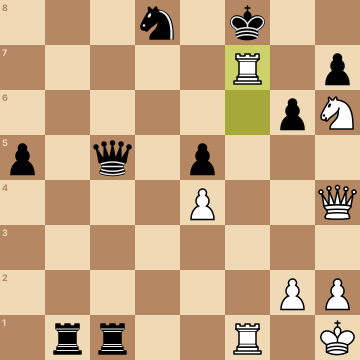
39.Rxf7+ — there it is, the position I've been aiming at for four moves.
Here's what I saw: 39...Nxf7 40.Qd8+ ! Kg7 41.Qf6+ Kxh6 42.Qh4+ Kg7 43.Qf6+ Kg8 44.Qxf7+ Kh8 45.Qf6+, perpetual check, and I shake a 2564's hand with half a point.
His king is under no obligation to take.
39...Ke8 !!
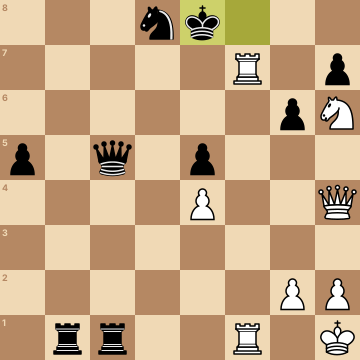
39…Ke8 !! — the king walks away, and nothing is defending my rook on f7.
0-1. I had calculated four moves and missed the simplest reply on the board. The game was very complicated, he saw one more move than I did, and I never had the draw in my hands: I believed it was mine for four moves.
Hats off to him, by the way. He left a very big impression on me, and on top of that he's a thoroughly nice guy.
Round 5 — Saturday 5 September, Black against Pascal Vianin (2017)
Second classical game of the day. I don't eat, I don't watch a single game, I go and walk outside for twenty minutes replaying 39...Ke8 on a loop — exactly the preparation you shouldn't do.
Across the board, Pascal Vianin. The table says 2017, his classical list says 2077, and his past says 2250. He never picks the wrong plan.
He leaves theory on move five, we trade the light-squared bishops, and I play 9...Qd7. Then, two moves later, the move that decides the whole game.
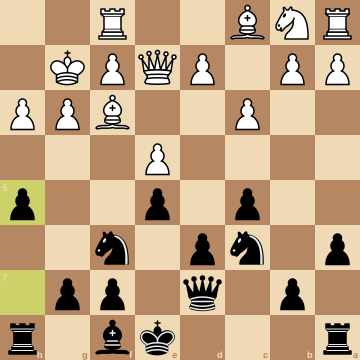
10…h5 — my king is still in the centre and this looks like no attack at all. That's right, it isn't one.
The idea fits in one sentence: I want to trade the dark-squared bishops and be left with knights against his bishop. h5 forces him to answer g4, g4 freezes the structure, a frozen structure closes the position, and a closed position is a bishop's worst enemy.
The engine, after the fact
The plan had an antidote of insulting simplicity: 10.h4, and there is nothing left to provoke.
11.d3 h4 12.g4 Be7 13.Na3 Nh7, a move that looks like nothing: it frees g5 for my bishop. That's the whole idea behind h5. One detail in passing — 14...Bg5 immediately loses to 15.Nb6, so 14...Rb8 first.
15.Nb6 Qd8 16.Nd5 Bg5 17.Be3 O-O 18.Qd2 Ne7 19.Nxe7+ Qxe7 20.Bd1 Bxe3 21.fxe3. The dark-squared bishops are gone, I'm left with two knights against a bishop, and I set about taking away what little that bishop had left.
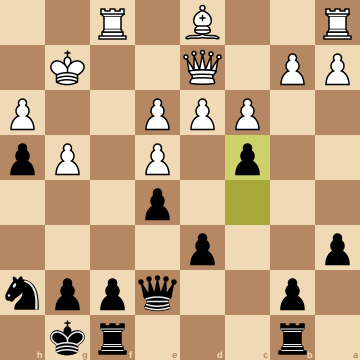
21…c4 — the white bishop is at home, and it will stay there until the handshake.
21...c4 !? 22.dxc4 Ng5 23.Bc2 Rbc8 24.b3 Rc6.
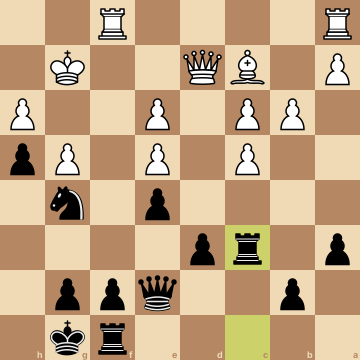
24…Rc6, and the move I should have played is right next door.
24...b5 ! would have opened everything, and I didn't see it. I was too busy admiring my walled-in bishop.
The engine, after the fact
And the break doesn't win the way I imagined: you have to recapture first, 25.cxb5 axb5 !, and only then 26.a4 Qc7 !! The continuation I vaguely had in mind, 25…Qc7 straight away, doesn't do the same thing at all.
25.a4. He shuts the queenside before it occurs to me to go back there, 25...a5 locks the lot, and the queens come off. ½–½.
The plan launched on move ten worked exactly as advertised. One move was missing to make something of it, and that's the one that got away from me.
Round 6 — Sunday 6 September, White against Hervé Lanois (1821)
Sunday morning, 3.5/5. Across the board, the player who beat one of my mates the day before. I very much want to win this one.
He plays the French Rubinstein, the line where Black gives back the centre on move three so as not to get shut in. My theory runs out on move ten and we play.
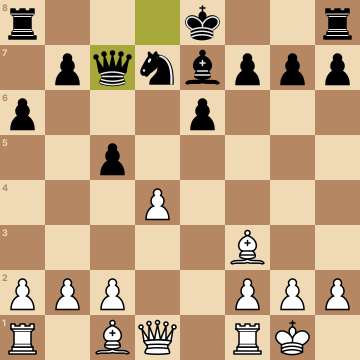
My d-pawn has been waiting since the start of the game. It's waiting for d5.
I already had that push in hand a move earlier: 12.d5 looked less strong to me while his bishop wasn't committed. I develop mine with 12.Bf3, he plays 12...Qc7, and in I go. 13.d5 O-O 14.dxe6 fxe6 15.Qe2 e5.
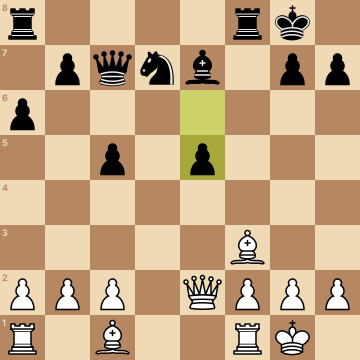
15…e5 — the pawn moves one square and gives up an entire colour.
By advancing, the e-pawn stops covering d5 and f5, and leaves e6 behind it: three holes in one move, all of them light squares. And he has nothing left to hold them — his light-squared bishop disappeared on move nine, and I kept mine.
I didn't leap out of my chair. I read the position twice to check I wasn't dreaming, then I started looking for somewhere to park my pieces.
16.a4, and I can see you coming: no, this is not a queenside plan. 16...Rad8 17.Ra3 Kh8 18.Rb3
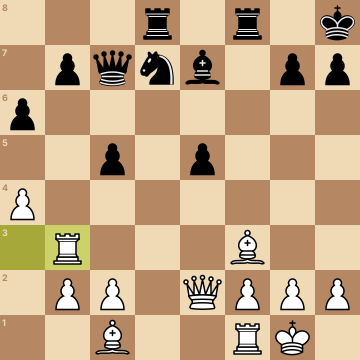
a1, a3, b3 — my rook is taking the grand tour. It hasn't finished.
a4 was only ever there to free a3 for the rook, which now crosses the board along the third rank.
The engine, after the fact
My little tour only held up because he played 16…Rad8. After 16…Nf6 ! the rook never arrives, and 18.Ra3 ? even lets 18…c4 ! restore the balance. The move I'm proudest of in this game was refutable one move later.
18...Rb8 19.Be4 Nf6 20.Rh3, and it arrives. The bishop on e4 and the rook on h3 are both looking at h7, and h7 is a light square. One more move to get everything in place: 21.Qc4+ Rf7.
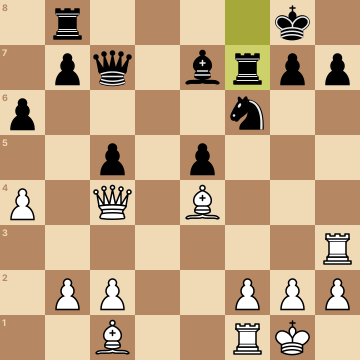
I'll let you calculate. It doesn't take long.
22.Bxh7+ Nxh7 23.Rxh7+ Kxh7 24.Qxf7
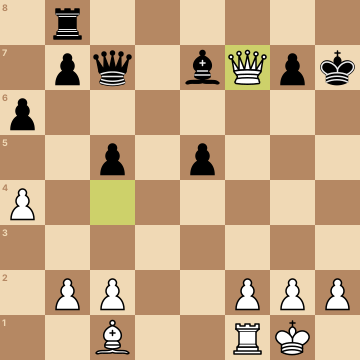
King in the open, two pawns up, and his b8 rook still hasn't done a thing.
Right. Now I have to be clean about it.
The engine, after the fact
The sacrifice works, but it wasn't the fastest: 22.Bf5 ! first, threatening Be6, and there is no defence left.
I don't rush the rest: the queen comes back to c4 then e4, the bishop goes to fetch his, the rooks trade on the d-file — 31.Bxc5 Qxc5 32.Rd8+ Rf8 33.Rxf8+ Qxf8 34.Qxc4+ Kh8 — and 35.Qc7 ends it. 1-0.
Two moves cost him the game, 15...e5 and 16...Rad8, and I had twenty moves to cash them in quietly.
Round 7 — Sunday 6 September, Black against Cédric Pahud (2142)
4.5/6, last round, fourth classical game in two days. The legs are fine, the head slightly less so: since Friday evening I've played seven times and I'm starting to mix up positions from one game to the next. A win here and I climb a long way up the table.
Across the board, Cédric Pahud, whom I'd already drawn with three weeks earlier at the team championship, with Black then too.
He plays an English and puts both bishops on the long diagonals. I answer with a King's Indian structure. On move eleven, I have a choice to make. I know the move is 11...Nh5. I know it the way you know a phone number you haven't dialled in ten years: the shape is there, the digits won't come. Impossible to reconstruct how I defend my pawn after 12.Nb5. So I play 11...Ne8, which is not the move.
12.Nd5 f5 13.Nec3 h5
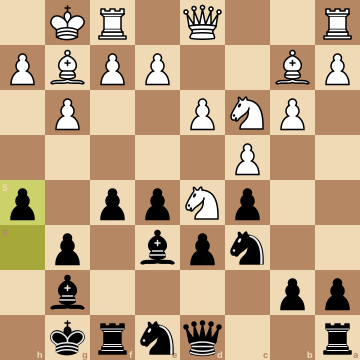
13…h5. The plan has a name, and it isn't the name of an opening.
My plan fits in three words: make a mess. I'm working on the assumption that I calculate better than he does and that a muddled position will play for me. That may be a touch ambitious.
14.e3 h4 15.f4. He reacts perfectly, closes the centre at the right moment, and my mess starts bothering me more than him. 15...Rf7: I spend an unreasonable amount of time looking for an idea, and the one I find isn't much good.
16.Qe1 Bh8 17.gxh4 Rh7 18.Qg3 Kf7 — my king walks up to the front because there's nobody else to hold h7. Then he plays 19.h5, and I have time to see what 19.Ne4 !! would have done to my position.
19...Rxh5 20.Bf3 exf4 !
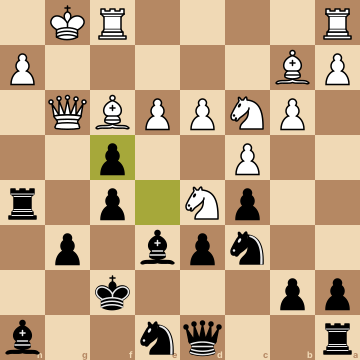
20…exf4 — the point. For once the line I'd calculated does what it promised.
The engine, after the fact
I was breathing out one move too early: 20.Ne4 !! was still winning. The same square twice in two moves, twice left alone.
21.exf4 Rh6 22.Rae1 Nd4 23.Bd1 Qh4
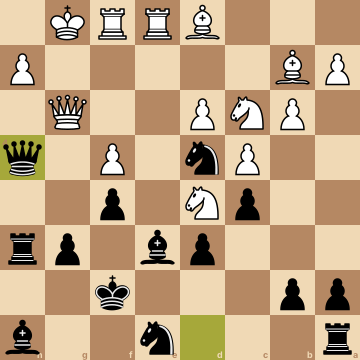
23…Qh4, and I offer a draw.
I offer a draw. Not because I want it — I'm better — but because it tends to irritate him, and irritated, he goes astray. It isn't very elegant, and it works immediately.
24.Re3 ?? He had to trade queens. As for 24.Qg5, I'll let you look: 24...Qxh2 is mate.
24...Nc6 !! The move I'm happiest with all weekend: it defends e7, it unblocks everything, and it puts every one of my pieces back into the game in a single stroke.
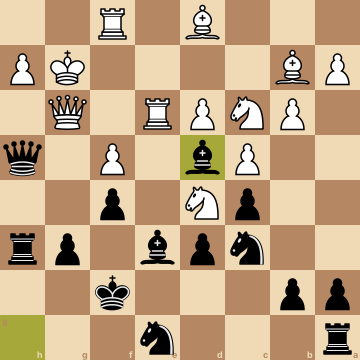
25…Bd4. I had to take first.
25.Kg2 Bd4 ?? I play it quickly, pleased with myself, because a bishop on d4 looks nice. The won game was one move away, and it all came down to the order: 25...Bxd5+ ! first, and after 26.Nxd5 Qxg3+ 27.hxg3 Bxb2 Black wins.
A move order. Another one.
The rest trades itself off and what's left is an endgame with my knight facing his bishop, pawns hooked into one another. ½–½.
And I should have played that endgame out. It isn't so easy for him to hold, my pawns aren't bad, and we were on five minutes each — except that with thirty seconds a move, five minutes is plenty to push wood for forty more. Two days earlier, in rapid, I'd have pushed them without a second thought.
Tournament summary
5 / 7, seventh out of seventy-five, one single loss and it's signed by the tournament winner. 3/3 on the Friday evening in rapid, 2/4 over the weekend at the classical time control.
The Elo count, done again by hand
Seven games, but two tournaments as far as FIDE is concerned: the three Friday rounds count towards my rapid list, the four weekend games towards my classical one. Chess-results, meanwhile, runs the lot through the same rapid formula and displays a single change of −1 point, which describes neither.
The real count, in rapid, with the K = 20 of that time control and the rating gap capped at 400 points:
| Round | Opponent | Rapid Elo | Gap | Expected | Actual |
|---|---|---|---|---|---|
| 1 | Farine, Amael | 1743 | 502 → 400 | 0.92 | 1 |
| 2 | Chappaz, Max | 1906 | 339 | 0.88 | 1 |
| 3 | Rotunno, Flavio | 2031 | 214 | 0.77 | 1 |
| 2.57 | 3 |
20 × (3 − 2.57) = +8.6 points, and my rapid rating goes from 2245 to around 2254. On the classical side, the four weekend games give +0.4: the loss to Petrov costs almost nothing since he was giving me 437 points, and the two draws take back what the win had brought in.
+8.6 in rapid, +0.4 in classical. Not a single "−1".
What I take away from Monthey
On the Friday evening I played fast because I trusted my decisions. On Saturday and Sunday, as soon as the positions got complicated, I went back to doubting my calculations.
So the question isn't really whether I know what to play any more. It's whether I'm able to check, all the way through, what I think I've seen.
That lines up exactly with what I brought back from the team championship three weeks ago, with one difference that changes everything: the judgement is coming back. It's the calculation that's taking longer.
Checking a line all the way through isn't something you get by playing more: it's trained, session by session, with someone reading your calculations back to you cold. That's the heart of what I do in adult chess lessons in Geneva — and yes, I take the same medicine.